Sunday, August 26, 2012

Jesus Shock


Homily from the 21st Sunday of Ordinary Time - Year B
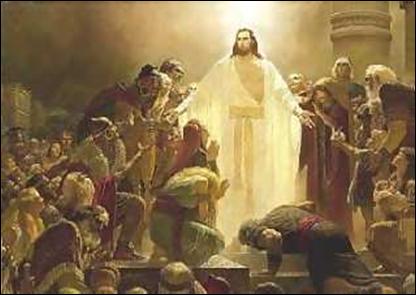
For the last five weeks, we’ve been listening to the sixth chapter of the Gospel of John in which we hear about Jesus’ miraculous multiplication of the loaves and fish and one of the most shocking speeches of all time: Jesus’ “Bread of Life” discourse.

In his “Bread of Life” discourse Jesus tells his disciples that they must seek not earthly food that perishes, but heavenly food that endures for eternal life; that he himself is this living bread come down from heaven; that the bread he will give is his flesh for the life of the world; and unless they eat his flesh and drink his blood, they do not have life within them.

Last week, we heard how some of those disciples of Jesus could not believe what they were hearing.  They took Jesus literally at his word.  “How can this man give us his flesh to eat and his blood to drink?” they asked.  They are pious Jews who know the law of Moses which forbids them from drinking the blood of any animal, let alone the blood of a human being, let alone eat the flesh of a human being.  But Jesus tells them again and again and again, “Yes, you understood me correctly.  Eat my flesh and drink my blood.”

And then the line in the sand is drawn.  “Many of Jesus’ disciples who were listening said, ‘This saying is hard; who can accept it?”  And Jesus asks, “Does this shock you?”  And indeed it does, for, as Scripture tells us, “As a result of this,” meaning, as a result of Jesus’ command to eat his flesh and drink his blood in the literal sense and not a figurative sense, “many of his disciples returned to their former way of life and no longer accompanied him.”

And Jesus let’s them go.  

He does not running after them saying, “Wait, hold on.  You’re right.  I only meant ‘eat my flesh and drink my blood’ in a figurative sense.”  Jesus said, “Eat my flesh, drink my blood.”  They asked, “Do you really mean that?”  Jesus said, “Yes.”  They said, “Nope, we’re outta here.”  And Jesus said, “Fine.”

Because Jesus meant what he said.  Those listening to him understood him correctly.  Jesus did not later alter his meaning.  And those who left, chose to stay on the opposite side of the line Jesus drew in the sand.

This isn’t a popular way of looking at Jesus.  Most would prefer a “nice Jesus.”  There isn’t a more boring word in the English language than “nice.”  Neil Armstrong, your the first human being to ever set foot on another celestial body other than Earth, what do you have to say about that?  “Hmmm.  This moon is nice.”

I had a professor in seminary who said when he is dead, if people say, “He was nice” then he failed in life.

Jesus didn’t come down from Heaven to be born in a feeding trough for animals and get nailed to the cross just so he could be a nice, cuddly Jesus.

I’m sure most of you are familiar with C.S. Lewis’ book “The Lion, the Witch and the Wardrobe” or have seen the movie.  You probably also know that the character of the lion Aslan is a figure for Christ.  (If you didn’t know this, reread the book or watch the movie again with that in mind and get ready to experience one of the greatest stories of the 20th century.)  Throughout the book, those citizens of Narnia who know Aslan well tell the children again and again, “Aslan is not tame lion.  Oh, he's good... but he's not tame."

Jesus is not cute, and cuddly.  He is not tame.  Jesus is shocking.

Click here to buy Jesus-Shock
I just finished an outstanding book on this subject called, “Jesus-Shock,” by Peter Kreeft who is often described as this generation’s C.S. Lewis.  And in it he asks the question, “Why is Jesus the most controversial and the most embarrassing name in the world?”  “No one is embarrassed if you talk about Buddha, or Muhammad, or Moses.”  But so many people are when you talk about Jesus.  “If you’re not sure my assumption is true,” Kreeft says, “test it, in any... mixed company... The name will fall with a thud, and produce sudden silence and embarrassment.”

Why is this?  Why is Jesus the most non-neutral name in the world?  Because Jesus is the most non-neutral person in the world.  “Jesus is a sword.  He divides” Kreeft says.  Remember Jesus’ own words, “Do not think that I have come to bring peace upon the earth.  I have come to bring not peace but the sword.  For I have come to set a man ‘against his father, a daughter agains her mother.’”  Peter Kreeft calls Jesus, “the razor edge of the round world?”

Jesus is not a boring, nice person.    “Jesus is the only man in history who never bored anyone.”  Just look at how every single person who encounters Jesus reacts to him in the Gospel:

In the Gospel of Matthew, when he finishes his sayings, “the crowds [are] astonished at his teachings.” (Mt 7:28-29)

When he tells the paralyzed man to rise, take up his mat and go home, “they were all amazed and glorified God, saying, ‘We never saw anything like this!” (Mk, 2:2-12; cf. Lk 5:18-26; Mt 9:2-8)

When Jesus calms the storm at sea, the Apostles “marveled” at him. (Mt 8:23-27; Lk 8:22-25)

When he raises the little girl from the dead, the people “were overcome with amazement.” (Mk 5:38-42; cf. Lk 8:51-56)

When Jesus himself appeared to his disciples after his resurrection, “they were startled and frightened.” (Lk 24:36-43)

And in today’s Gospel, when he draws the line in the sand over his command to eat his flesh and drink his blood, he asks “Does this shock you?”

Are we truly astonished and amazed by Jesus?  Do we marvel at him?  Are we startled or even frightened by him?  Does he shock us?

If not, we haven’t truly met Jesus yet.  We haven’t met the untamed lion.  We’re still settling for the cute, cuddly, stuffed version of him that sits on the corner of our bed and says, “Oh, don’t worry about me.  I’ll just sit here looking cute.  I won’t challenge you at all.”

Jesus is not boring.  He is God, who, as Kreeft says, “became a human zygote, fetus, baby, boy, teenager, man, and then corpse... [He gives] Himself to our mouths and our stomachs as well as our souls.  That thing that looks like a little piece of bread - that’s Him.  I certainly sympathize with most Protestants,” Kreeft goes on, “who do not believe that.  It is nearly unbelievable.  The priest puts God into your left hand, and you pick up God Almighty with your right thumb and forefinger and you swallow God Almighty, and He falls into your stomach.  That is crazy - as crazy as the Incarnation” God becoming man in the first place.

If Jesus doesn’t shock you, you haven’t met him yet.

Sunday, August 19, 2012

Gnawing... Chewing... Munching


Homily from the 20th Sunday of Ordinary Time - Year B

A couple of weeks ago, I arrived at the church to get ready to celebrate a weekday morning Mass.  It was 7:30.  As soon as I got out of the car, I heard three young voices shout out, “Fr. Andrew!  Fr. Andrew!”  It was three of our high school students, young ladies, who came running up to me.  I thought to myself, “What’s wrong now.”  They said, “Father, we just came from the Perpetual Adoration Chapel at St. Jude’s.  We’ve been there since midnight.”  They had spent the night in adoration before the Lord.  One of them said, “I didn’t know I could pray that long!”

In the Gospel today, Jesus tells the people that unless they eat his flesh and drink his blood, they do not have life within them.  And the Gospel begins with an objection by some of the people who hear these words.  They cannot believe that he would say something as graphic as “eat my flesh and drink my blood.”  They ask, “How can this man give us his flesh to eat?”

And Jesus responds by assuring them again, and again, and again, and again that he meant what he said: “eat my flesh and drink my blood.”  In fact, he reiterates it five more times.  He goes so far as to use a word that is even more graphic than eat.  In the original language the Gospels were written in, the typical word for eat is the word “phago.”  However, when Jesus says, “Whoever eats my flesh and drinks my blood has eternal life” the word he uses instead of “phago” is “trogo” which means “gnaw,” “chew,” or “munch”  Imagine if we had heard Jesus say in today’s Gospel “He who gnaws, chews, or munches of my flesh... has eternal life.”  But that is precisely what he is saying.

Jesus is telling us that the eternal life he wishes to dispense to us, truly comes through munching on his body and blood through the Sacrament of the Holy Eucharist.  And at the same time, I would propose that this gnawing, chewing and munching on Jesus is something that must extend after our consumption of the Blessed Sacrament.

Have you ever given a dog a bone?  What does the dog do?  It lays down on the floor, clutching the bone as best he can in his paws, and he gnaws, chews, and munches on the bone for hours and hours.  The dog is consumed, obsessed and fascinated with the bone and nothing else around them matters.  Perhaps thats how those three girls felt as they gnawed, chewed and munched on Jesus for hours and hours in adoration.

That’s the effect, gnawing, chewing, and munching on the Sacrament of the Eucharist should have on our lives.  We should then continue to gnaw, chew and munch on the person of Jesus Christ in our every affair.  In every moral decision we have to make.  In every friendship and relationship we engage in.  In every thought, word, and deed that comes forth from our mind, lips and actions.  So, let us gnaw, chew and munch on the Lord in this Sacrament and in every moment of our lives.

Sunday, August 12, 2012

Church is the Place Where We Get Married

Homily from the 19th Sunday of Ordinary Time - Year B


The top three questions grade school students always ask me are: Will my dog go to Heaven?  Have you ever performed an exorcism?  And why do I have to get married in the Church?

With regards to dogs going to heaven: I’ve attempted to answer this question a number of ways; some with moderate success, some with no success whatsoever.  Perhaps the best answer is one Monsignor John gives: “I’m certain that if its absolutely necessary for your salvation that your dog be with you in Heaven, then your dog will be in heaven.”

With regards to the second question, have you ever performed and exorcism?  Yes.  I’ve performed dozens and dozens of exorcisms.  There’s an exorcism in every baptism.  “Almighty and ever-living God, you sent your only Son into the world to cast out the power of Satan, spirit of evil... We pray for this child: set him free from original sin...”  So far I haven’t seen any heads spinning around.  But I’ve seen babies spit up green pea soup.

And lastly, Why do Catholics have to get married in the Church?  Initially, I would answer this question with a “Because I said so” type of response.  “Catholics have to get married in the Church because that’s where we get married.”  But this isn’t a satisfactory answer.  So I would try to flesh it out a bit by saying, “Church is where Catholics come for all the important things of life: baptism, funerals, weddings, 1st Holy Communion, Mass, etc.”

But in reality, the original answer is more satisfactory.  “Catholics have to get married in the Church because that’s where we get married.”  But this needs some qualification: Church is where we get married, not just when we receive the Sacrament of Holy Matrimony, but every time we come to Mass.  Church is the place where God marries us.

The analogy Sacred Scripture uses more than any other to describe the nature of the relationship between God and His people is marriage.

In Isaiah we read, “As a young man marries a virgin, your Builder shall marry you; and as Bridegroom rejoices in his bride so shall your God rejoice in you.” (Isa 62:5)

In the New Testament, John the Baptist calls Jesus the Bridegroom: “I am not the Messiah” John the Baptist says, “I was sent before him.  The one who has the bride is the bridegroom; the best man, who stands and listens for him, rejoices greatly at the bridegroom’s voice.” (Jn 3:28-29)

Christ calls himself the bridegroom.  People ask Jesus why his disciples do not fast.  “Can the wedding guests fast while the bridegroom is with them?  As long as they have the bridegroom with them they cannot fast.  But the days will come when the bridegroom is taken away from them, and then they will fast on that day.” (Mk 2:19-20)

Jesus also refers to himself as the bridegroom through parables:  “The kingdom of heaven may be likened to a king who gave a wedding feast for his son.  He dispatched his servants to summon the invited guests...” (Mt 22:2-3)  “The kingdom of heaven will be like ten virgins who took their lamps and went out to meet the bridegroom...” (Mt 25:1)

When St. Paul explains the type of love husbands and wives should have for one another, he points to the marriage between Christ, the bridegroom, and the Church, his bride:  “Be subordinate to one another out of reverence for Christ.  Wives should be subordinate to their husbands as to the Lord... Husbands, love your wives, even as Christ loved the Church and handed himself over for her... husbands should love their wives as their own bodies... even as Christ does the Church... this is a great mystery, but I speak in reference to Christ and the church.” (Eph 5:21-32)

When sociologists describe social relationships, they often divide them up into two categories: One is a society, which are formal organizations of people with structure and offices such as the secular state, schools, hospitals, etc.  The other is a community, which are informal organizations of people who are intimately connected with relative permanence such a the family, a household, or a neighborhood.

The Church is both a society and a community.  As a society, the Church is a formal organization of the People of God with a hierarchical structure and law to govern them.  This is the horizontal dimension of the Church as we look across the spectrum of members.  However, if the Church were limited to this horizontal dimension alone, we would view our association with God as merely a matter of friendly relationships between God and man.  What is distinctive to the Church is a vertical dimension in which the divine life of God comes down to earth, becomes incarnate in the person of Jesus Christ who communicates this divine life to men through the Holy Spirit.

You could say, therefore, that we have a kind of cruciform theology of communion among men and between the human and divine.  Through the arms of the cross, Christ gathers and unites all of mankind into one Church.  And through the tree of the cross, Christ lifts his bride, the Church, into union with the Father.

And it is appropriate that the Church should be married to God through the Cross, for on the Cross, Christ reconciles the divorce between man and God and among men.  Man divorced himself from God by stretching his hands out to the tree to take the fruit for himself.  Christ restores the marriage by stretching his hands out to the branches of the tree so that the fruit of the Spirit might pour fourth through the Church.  God cast a deep sleep upon Adam so that from his opened side, his bride, Eve might be formed.  God cast a deep sleep upon Christ, so that from his opened side, his bride, the Church, might be formed.  From Christ’s open heart, flow the two great sacramental of the Church, water and blood signifying baptism and the Eucharist.

Through baptism and the Eucharist, Christ prepares and unites himself to his bride.  In ancient Jewish custom, part of preparation for marriage was a ritual washing of the bride prior to the wedding itself.  Likewise, we the Church, the Bride of Christ, is washed and purified through baptism, prior to our union with the Bridegroom through the Eucharist

Paul alludes to both these washings, of the bride before her wedding night, and of the Bride the Church in Ephesians:
“Husbands, love your wives, even as Christ loved the church and handed himself over for her to sanctify her, cleansing her by the bath of water with the word, so that he might present to himself the church in splendor, without spot or wrinkle or any such thing, that she might be holy and without blemish.” (Eph 25-26)

If you look in your pews, you’ll notice handouts with a couple pictures.  The picture on the left is a canopy over a royal wedding bed on which bride and bridegroom united.  The picture on the right is the baldachino over the altar at St. Peter’s basilica in Rome.  You’ll notice the architecture of the two are strikingly similar.  From the four posts and the crowned roof, down to the scalloped trim and tassels on the top.  This is because, just like the royal wedding bed, the altar is the place where Christ, the bridegroom unites his flesh to ours through the Eucharist.


We don’t come to Church just so we can hang out with other people who share common believe, common worship,  common prayer, or common interests.  We don’t come to Church just to hear good music and interesting sermons.  We don’t come to Church just to meet a Sunday obligation.  We don’t even come to Church just to feel good about ourselves.

We come to Church to be made holy by Christ.  To be purified by him.  We come to Church to become united as one with Jesus Christ.  We come to Church so that through the Eucharist, through his Body given up for you; the two: the human and the divine, you and Jesus, may become one flesh.  We come to Church to be married to Christ.

Sunday, August 5, 2012

Food That Endures

Homily from the 18th Sunday of Ordinary Time - Year B

Do you remember when wallets had the giant fold out sleeve for pictures?  Do they still make them like that?  They don’t seem to be as popular as they once were.  You remember... your friend or relative would say, “Lemme show you pictures of my kids.”  And with a flick of the wrist, a trail of pictures, linked together by conjoined transparent pockets would fall all the way to the ground.

So, if you’ll permit me for a moment, I’d like to brag a bit about my kids; about your kids.  Wednesday night, around 6:30, I’m putting some things away in the back sacristy here and I come out to find 10 of our teens walking into the Church, rosaries in hand, gathering in the Immaculate Heart of Mary alcove.
It’s summer vacation.  A beautiful sunny afternoon, and here are a bunch of teenagers praying to Jesus with one another and their mother.

Why?  Is it because they’re holy kids?  They are.  We all are.  As sons and daughters of God, we are inherently holy.

Is it because they want to grow in holiness?  Yes, I think very much, they want to grow in holiness.

Is it because they want to feel good?  Perhaps.  I’m sure their prayer with one another, with Mary, with Jesus, and with God brought them joy.

Is it because they feel bad?  Perhaps.  Perhaps they are experiencing some trial or suffering and I’m sure their prayer brought them some consolation.

There’s another reason why I think these teens came to pray on a sunny, summer afternoon.  They’re hungry.  They’re hungry for that which truly satisfies.  They’re hungry for what Jesus calls in today’s Gospel, “food that endures for eternal life.”  They’re hungry for the Bread God the Father sends down from Heaven: His own Son Jesus Christ, the Bread of Life.  And they came, have come and will continue to come to the Church to be fed.

Occasionally, I’ll spontaneously decide to go spend a little time in Eucharistic Adoration.  It’s one of the best perks of being a priest.  You want to have Adoration, you can do it whenever you want.  Just get out the monstrance, insert Blessed Sacrament and away we go!  Well, quite often when I do, I’ll send a tweet out that says something like “Eucharistic Adoration in the Blessed Sacrament chapel today from 3-4.  Go!”

And you know what happens?  Each and every time, a handful of our teens will show up to worship the Lord.  (As well as other parishoners.)  By the way, if you want to follow me on Twitter, my handle is @fatherbudzinski.

More and more it seems, the young people of our parish and many others, young and old, are seeking a deeper, increasingly authentic intimacy with the Lord.  Years ago, Eucharistic Adoration was sometimes looked upon with suspicion.  Now, it’s one of our teens favorite ways to pray with the Lord.  People are making courageous returns to the Sacrament of Reconciliation after decades of being away.  Just a few months ago, over 1,500 men gathered at the Coliseum for the Rekindle the Fire men’s conference and women gathered likewise for the Arise conference.  Couples are stepping forward wanting to embrace Natural Family Planning.  Couples who had been married outside the Church are inquiring about having their marriage blessed so they can receive the Eucharist again.  Men and women from our parish are going on Christ Renews His Parish weekend retreats and talking about how it has changed their lives.  Record numbers of teens are going on our Life Teen and Edge retreats.  We already have a big number of people interested in beginning RCIA and becoming Catholic this Easter.  And the list goes on and on.

Why?  What’s so special about taking part in Church stuff?  Isn’t that just for Jesus Freaks?  No.  It’s for everyone who is hungry; hungry for food that endures for eternal life.  
The food that perishes are those things, temporary entertainments and distractions that do not, that cannot, satisfy our natural hunger for God that each of us possesses which can only be satisfied by God.
Food that perishes comes in the form of money, material goods, clothing, power, achievement, status.  Not that money, material goods, and status are evil.  They’re not.  It’s OK to have those things.  But they cannot be the “bread” on which we live.  They cannot be our Bread of Life.

Jesus tells us today that he is the Bread of Life.  And every single person in the world is hungry for this Bread whether they know it or not.

That’s why 10 teens walked into the Church on a sunny, summer afternoon to pray a rosary.  Not that teens are the holiest ones in the church.  But they are are good example to observe because perhaps more than any other demographic, teenagers are sold a buffet of food that perishes on a continual basis.  Having the latest technology.  Having the best clothing.  Having the “right” friends.  They’ve tasted the food that perishes for eternal life.  And you know what, more and more of them are becoming bored with it.  Thank God!  They are coming to realize that nothing can satisfy their infinite souls except the infinite food God offers them.

If you are beginning to, or have found, the things of this world to be a bore...  If you’re experiencing a lack of direction in your life...  If it seems as though real joy is missing... Or, if you simply dissatisfied with a one hour per week relationship with Jesus Christ... Maybe you’re becoming more and more aware of the God-sized hole in your soul and the inability of any thing or any person in this world to fill it.

That realization is a cause for great joy.   For you are discovering that something is missing in your life.  And you are discovering the only one who can provide what is missing: Jesus Christ, the Bread of Life, food that does not perish, but endures for eternal life.

Sunday, July 29, 2012

Fifty Shades of Grey


Homily from the 17th Sunday of Ordinary Time - Year B

Today’s Gospel begins one of the most important chapters of the Gospel of John: Chapter 6 which contains, as we just heard, the miracle of the feeding of 5,000.  Which, of course, foreshadows the Last Supper.  As we heard today, Jesus took bread, said the blessing, broke the bread and gave it to the 5,000.  And in the weeks to come, we will continue to listen to Chapter 6 from the Gospel and John and hear what is known as Jesus’ Bread of Life discourse.  In which he tells us clearly and without ambiguity that the bread he gives us in the Eucharist is not a symbolic representation of his Body, but in fact, his very Body and Blood.

The event of the Last Supper raises a question: why did Jesus choose food as the vehicle by which to make himself substantially present to us?  Why did Jesus choose to remain with us under the form of bread and wine?  Why food?

There are a number of reasons, I think.  We could say that Jesus gives himself to us under the form of food because we cannot survive without food.  Likewise, we cannot survive without the food of Heaven, his Body and Blood.

We could say that Jesus gives himself to us under the form of bread and wine because it shows us how many grains are used to make one loaf and many grapes are used to fill one chalice.  Likewise, we, the many, are made one through his Body and Blood.

We could say that Jesus gives himself to us under the form of grains of wheat and cluster of grapes that each must be crushed so that we may see his own crushing if you will, his Passion and Death, so that we might live.

Another reason I’d like us to focus on today however, is this: Jesus gives himself to us to be eaten as food so that we might become like him.  We understand this better by another phrase: “You are what you eat.”  When we eat ordinary food, it becomes part of us.  When we eat the supernatural food of the Eucharist however, we become what we receive.

Whatever we take within ourselves, we are transformed into.  And this is true not only by what we eat, but whatever we take in through the senses.  There’s an old saying that goes, “You become what you gaze upon.”  St. Paul said it similarly in his second letter to the Corinthians.  He describes growing in holiness by contemplating the divine when he says, “All of us, gazing with unveiled face on the glory of the Lord, are being transformed into the same image” (2 Cor 3:18)

If we are fascinated with what is holy, with what is of God; if we fix our gaze, our attention, our interest, our passion on God, we will be drawn into Him; we will be united with Him.

However, if we become fascinated with that which is not holy, that which is not of God; if we fix our gaze, our attention, our interest, our passion on sinful things; we will be drawn away from God; we will be separated from Him.

Of course, when one thinks about those things that we might look upon that pull us away from God, one cannot help but think of pornography.

Pornography is most commonly a temptation that afflicts men.  Men are more drawn to pornographic pictures and videos because they are more visually stimulated.

However, it’s not a problem exclusive to men and it’s not a temptation that manifests itself exclusively via indecent images.  Pornography can also appear in the form of indecent stories, narratives and fictional writings.  And this is a temptation that tends to afflict women because women are more relationship oriented.  So novels, soap operas and chat rooms tend to be the temptation.

Years ago, this temptation came in the form of the so-called “romance novel.”  Now, we see at the top of the New York Times Bestseller list, “Fifty Shades of Grey.”  This novel, I’m told, can be called anything but a “romance novel.”  By the reports I’ve read, it simply is hard core pornography, depicting human sexuality in a an abusive and degrading manner.  Dr. Drew Pinsky, a psychologist often seen on CNN, says it depicts “a pathological, abusive relationship that in now way resembles a healthy love life.” 

Now do me a favor, now that I’ve mentioned the name of this book, don’t go running off to the bookstore, to check it out for yourself.  Whenever I recommend a religious book, All Saints gets a bunch of requests for it.  Please don’t go into All Saints and say, “Fr. Andrew mentioned a book called ‘Fifty Shades of Grey,’ do you have that?”

And don’t be fooled.  Just because a book does not contain pictures of unclothed people doesn’t mean it’s not porn.  And just because it’s fictional, doesn’t mean it’s not hurting anyone in particular.  If anything, a work of fiction, that twists the beauty of human sexuality into something perverted, hurts the entire human race because it’s doesn’t just reduce a particular person to an object, but makes all of humanity and all of sexuality something to be lusted after and used.

The devil is very cunning you know.  He is slick in how he tempts us.  The devil is incapable of creating anything.  Only God can create ex nihilo, or “out of nothing.”  So the devil must take the good things that God has created, those things which are naturally attractive and desirable, and twist them into a counterfeit, a lie in order to get us to take his bait.

In the case of pornography, Satan takes the beauty of the human body and twists it into something to be lusted after.  And in doing so, he separates us from God and from one another.  For if we look upon images of the human body which do not depict the human person with true dignity, we reduce the person depicted in the image to a mere object.  And if we reduce the person in the image to a mere object, we reduce ourselves to mere objects.

If we look upon, or read, pornography, we become pornographic persons.  We become what we gaze upon.  We become what we receive.

In your prayer tonight, I ask to you to consider the things you consume: the things you look upon, the books you read, the movies you watch, the music you listen to and the internet sites you visit. And as you do so, ask yourself this question:  “Do the things I read and look upon depict human sexuality according the eye of God or according to the lie of Satan?”  If what you read pleases God, wonderfully done!  Keep up the good work.  If what you read pulls you away from God and the way He designed human sexuality, allow Him to purify you.

This purification takes place via three steps.  First, purify your environment.  Throw away the book, throw away the magazines, put a filter on your computer.  Second, purify yourself.  Go to confession and allow God to cleanse your soul and save you from the fires of Hell.  Third, gaze upon that which is holy, that which is of God.

The best remedy for an attraction to pornography is to turn our eyes away from what is sinful and fix our gaze on Jesus in Eucharistic Adoration.  In Eucharistic Adoration, when we look upon Jesus, as as he looks upon us, we enter into real intimacy with him.  Just as when a husband and wife look into each other’s eyes.  More so!  For Jesus looks deep within our very souls and opens his Sacred Heart to us to be the object of our desire.  And as this exchange of divine love occurs between him and us, he transforms us into him.

If it becomes easier for us to find people who read “Fifty Shades of Grey” than it is to find people willing to look upon the Body of Christ in Adoration, we’re in a heap of trouble.
And the Lord tells us this not because we are bad, but because we are good and He wants to prune away those things which destroy our dignity as human beings created in His Divine image and likeness.

So, let us turn our gaze away from all that is sinful and fix our gaze on God.  Let us ask Him to make us pure and to draw us into union with Him.  Let us never be afraid to ask for His mercy when we have fallen, confident that He will grant it to the contrite heart.  And let us become what we receive through this Eucharist.

Sunday, July 15, 2012

Divine Adoption


Homily from the 15th Sunday of Ordinary Time - Year B

When St. Paul wrote his letters to the various ancient Churches, such as the Churches in Rome, Corinth, Galatia, and today’s letter to the Church in Ephesus, he always began these letters with two parts: first, a greeting, immediately followed by a blessing
Our worship today at Mass began with a greeting Paul used over and over again in nearly all of his letters: “Grace to you, and peace from God our Father and the Lord Jesus Christ.” (Eph 1:2)
And in today’s second reading, we hear the blessing, Paul sends to the Ephesians: “Blessed be the God and Father of our Lord Jesus Christ, who has blessed us in Christ with every spiritual blessing in the heavens.”  And so on.
Then what follows, in the letter to the Ephesians, is the body of the letter, which can be divided into two parts.  First, there’s what you might call a catechetical section.  In this section, Paul teaches the people about their salvation through Christ.  How we were dead in sin (Eph 2:1).  But God, who is rich in mercy, raises us up to new life through Christ (Eph 2:6)

The second part of the body of the letter is what you might call an exhortation for us to embrace this new life in Christ in our daily living.  In this section, Paul calls Christians to unity (Eph 4:1-16).  To put aside vice and embrace virtue (Eph 4:17-5:20).  Husbands and wives are to be subordinate to one another (Eph 5:21-32).  Children are to obey their parents (Eph 6:1-4).  And all this is to be done amidst constant prayer (Eph 6:18-19).
The letter to the Ephesians is an appeal to conversion.  Leaving one life behind and entering into another.  This conversion takes place through a particular act by God.  And St. Paul uses a very specific word to describe this act and I’d like for us to reflect on it for a moment today.  Listen to these words of St. Paul from today’s second reading: “In love he [God] destined us for adoption to himself through Jesus Christ.” (Eph 2:5).
Adoption.  It’s an interesting word choice on the part of St. Paul isn’t it?  We are adopted children of God.  Why does St. Paul say we’re adopted and not just children of God?
We are sons and daughters of God, yes.  But, we’re different, right, from the way in which Jesus is the Son of God?  Jesus is the natural Son of God, meaning that Jesus shares the same nature with God the Father.  They share the same substance.  Or, as we say in the Creed, Jesus is “consubstantial” with the Father.
But we’re not of the same nature as God.  And yet, He wishes to resolve this.  God wishes to draw us, through conversion, into His divine nature.  How does He effect this?  Through Jesus who takes on our nature.  Jesus becomes man, and shares in man’s nature, so that man may share in the Son’s divine nature.  We become by grace, what Christ is by nature.
And what’s amazing is, that despite our being adopted sons and daughters of God, we are no less His sons and daughters, than even his own natural son, Jesus Christ. Jesus himself tells us this.  As he is praying to the father the night before his death in Chapter 17 of the Gospel of John, he says to the Father, “you loved them even as you love me.”

Those of you who have adopted children of your own know this is true just as you know you’re adopted sons children are no less your children than your natural children.  As adopted sons and daughters of God, we share in the same rights and privileges, the same honor and dignity, the same love and devotion, Jesus receives from the Father.
Consider what adoption meant in the time and place in which Paul was writing.  In 1st century Rome, adoption was most often enacted when a wealthy and affluent adult wanted an heir who would receive the inheritance.  God the Father is the fullness of wealth and affluence, far beyond any material sense and He desires you and I to be his heirs to His Kingdom.

In 1st century Rome, the child chosen for adoption was very often a slave.  God chooses us, and pulls us out of our slavery to sin into his grace.

When adopted, the child would leave behind their former family and enter into the new one, experiencing a change in social status and class.  When adopted by God, we leave behind lives of sin and enter into His royal family.

Adoption then, was, as it is now, a very expensive process.  There was a debt to be paid.  God pays the ultimate price, with the offering of His Son’s life, to erase the ultimate debt, our sins.

Over the next several weeks, we are going to hear more of St. Paul’s letter to the Ephesians.  I encourage you, as we do so, to read the letter in it’s entirety as part of your daily personal prayer.  As you do so, read with the eyes of God’s own adopted sons and daughters.  Grateful for the salvation He has rendered unto you.  With a docile heart open to conversion

Sunday, June 17, 2012

Humble Beginnings - Grand Results

Homily for the 11th Sunday of Ordinary Time - Year B


Who’s been to the Grand Canyon?  It’s magnificent isn’t it?  I haven’t actually been to the canyon, I’ve only flown over it a couple of times.  But even from thousands of feet up in the air, it’s a magnificent site.
The Grand Canyon is 277 miles long, up to 18 miles wide and attains a depth of over 1 mile.
It goes without saying, of course, that it didn’t always look that way.  At one time, the Grand Canyon was anything but grand - it had humble beginnings.  You could say that that 277 mile long, 18 mile wide and 1 mile deep scar in the earth began with a single drop of water
when the Colorado River was first formed and began to gently flow over the Colorado Plateau.
And it also goes without saying, of course, that it didn’t get that way overnight.  The steady and constant flow of the Colorado River and the imperceptible, microscopically slow rise of the Colorado Plateau worked against each other for at least 17 million years to bring the canyon to it’s present form.
The Grand Canyon shows us that the tiniest amount of force, the slightest amount of pressure, the littlest amount of effort (if applied steadily over time) can yield amazing results.
Jesus describes the Kingdom of God as such - humble beginnings that grow into grand results: “It is like a mustard see that, when it is sown in the ground, is the smallest of all the seeds of the earth.  But once it is sown, it springs up and becomes the largest of plants and puts forth large branches, so that the birds of the sky can dwell in its shade.” (Mk 4:31)
Now you have to understand that when Jesus talks about the Kingdom of God, he’s not just talking about Heaven for when after we die.  He’s also talking about the Kingdom of God here, now, on earth.  Jesus says all the time, “The Kingdom of God is at hand.” (Mk 1:15)
He’s talking, of course, about the Kingdom of God breaking into the world through his own presence here on earth.
Jesus is also talking about the building up of the Kingdom of God through the Church.  The Church began humbly - with Mary and the Apostles locked in an upper room and the descent of the Holy Spirit at Pentecost.  sAnd it has grown over the course of 2,000 years to a religion with over a billion members.

Our own parish is much the same way.  We began humbly.  Fr. Benoit came from France and met local farmers who donated the land on which was built our first church - a log cabin.
Since then, we have grown into a parish of over 10,000 the largest in the diocese.
You and I are much the same way.  We begin humbly - coming into existence through the joining together of two cells.  And we grow into the people we are today - not just bodily of course, but spiritually as well.  Coming to know our God, coming to love our God and coming into relationship and intimacy with our God.
It goes without saying, of course, that our Church, our parish and we ourselves, do not get this way overnight.  Not everyone is a St. Paul who God knocks off their horse and converts overnight.  Like the Grand Canyon, we do so with slow, steady growth.
One of my favorite singers is a Catholic named Audrey Assad.  And she’s written a song about growing in intimacy with the Lord - it’s called, appropriately so, “Slow.”  It’s a song, sung to God, in which Audrey sings:
Click here to purchase
 Audrey Assad's album "Heart"
You’ve drawn so close
That it’s hard to see you
And you speak so softly 
That its hard to hear you
Faith is not a fire
As much as it’s a glow
A quiet lovely burning
Underneath the snow
Cause love moves slow
Love moves slow


Spiritual growth is something that requires time.  This is something we lack.  We want answers to our prayers now.  But spiritual growth also requires docility - meaning a willingness to let God do the work and form us, not the other way around.
Jesus reminds us in the Gospel that it’s not us, but God who does the growing.  The Kingdom of God is like a seed that is scattered on the land.  And as the farmer sleeps and rises day and night, “through it all the seed would sprout and grow, he knows not how.  Of its own accord the land yields fruit, first the blade, then the ear, then the full grain in the ear.”
If a single drop of water, placed in the right place, at the right time, and given enough time to build and flow can cut a 277 mile long, 18 mile wide and 1 mile deep canyon.  What would become of us if we would allow God to form us steadily every day of our lives?
What would happen to us if we allowed God to speak to us for just a couple minutes of silent prayer everyday?  What if we consistently did that every day of our lives?

What would become of us if we made a 5 minute visit to the Blessed Sacrament Chapel once or twice a week on our way to or from work?  What if we consistently did that every week of our lives?

What grand results would God yield in us if we went to confession once a month?  What if we consistently did that every month of our lives?
What would we become?  In the hands of God... something grand indeed!