Sunday, July 31, 2011

Taken, Blessed, Broken, Given

Homily from the 18th Sunday of Ordinary Time - Year A

Do you know what a motif is?  It’s a French word that means “dominant idea or recurring theme”  You see and hear motifs all the time in books, movies and music.  For example, if I hummed the Imperial March, you’d immediately think of Darth Vader – it’s his theme song, it’s the motif that plays over and over again to let you know he’s nearby.

There are a number of motifs in Salvation History, the story our being saved by God; recurring themes such as the fall and redemption, the many becoming the one and self-sacrificial love.

In today’s Gospel we hear another motif from Salvation History. It’s a motif that is repeated at the Last Supper. And it’s a motif that is repeated every single time we come to celebrate the Eucharist at Mass.  This particular motif is a four-step process.  It’s what Jesus does to the bread; a four-fold action: Jesus takes, blesses, breaks and gives.

This miracle of the multiplication of loaves and fishes is the only miracle that is recorded in all four of the Gospels.  It's a very important miracle.  Important because it points to the same thing Jesus will do to the bread at the Last Supper.  It’s what Jesus will do to the bread when he eats with the two disciples on the road to Emmaus.  It’s what Jesus will do to the bread in a few moments when the bread is changed into His body on this altar.  Jesus takes, blesses, breaks and gives.

And it’s what Jesus does to you and I in our lives of continual conversion in Him.  Jesus takes you, he blesses you, he breaks you and he gives you.

Jesus takes you.  Another way of saying this is that Jesus chooses you.  Think about that for a moment, Jesus chooses you!  Jesus says, “It was not you who chose me, but I who chose you.” (Jn 15:16).  Perhaps that’s a difficult thing for us to understand sometimes. 

God chooses me?  Yes. God loves you. Remember what Fr. David Mary said at our parish mission?  He reflected on Jesus’ words at the Last Supper in the Gospel of John when Jesus said to His Father: “You loved them even as you love me.”

St. Peter says, “you are a chosen race, a royal priesthood, a holy nation, a people of his own.” (I Peter 2:9).  St. Paul says, “he chose us in [Christ], before the foundation of the world.” (Eph 4:1).

Jesus takes you. He chooses you.

Jesus blesses you.  Another word for bless is benediction. For example, at the end of Eucharistic Adoration you receive the Benediction when the sign of the Cross is made over you with the Eucharist in the monstrance. It’s a blessing.  Benediction is a word of Latin origin. It’s actually two Latin words put together. “Bene” means “good” and “dictus” means “say.”  So “bene dictus” or “benediction” means "to say good." To say good things about someone. To speak well of them.

God speaks well of you. He says good things about you.  In Psalm 139 He says you “are fearfully and wonderfully made.”  In Psalm 17 He says you “are the apple of His eye.”  In Deuteronomy He says you are “His treasured possession”  Jesus says you are not slaves but “His friends” (Jn 15:15).  And again and again throughout scripture you are called beloved sons and daughters of God.

Jesus blesses you.

Jesus breaks you.  This is a hard one to accept sometimes.  But the truth is, unless Jesus breaks the bread, He cannot give it to so many.  In order for us to be gift, we have to be broken.  We are broken in that we all fall, we all sin.  But we’re also broken in the sense that Jesus breaks us. He breaks us of our sin.  A simple illustration is one that every athlete knows: “No pain, no gain.”

Jesus breaks you.

Jesus gives you.  I want you all to know something, but especially you teens.  Some of you, those of you who are married, already know this.  But I want those of you who await marriage to know that you are the greatest gift someone in this world will ever receive.  God has created you to be a gift to your future spouse.  Or if you’re called to be a priest or religious, to be a gift to Christ and His Church.  Or if you’re called to be a generous single person to be a gift for the building up of the Kingdom of God.

Jesus gives you.

In a few moments, we will see this same four-fold action, this same four-fold action unfold in front of our very eyes.  And as you watch those actions and hear those words, I want you to envision Him doing the same in your lives.

As bread and wine are taken and placed upon the altar, envision Jesus taking your lives, choosing you, claiming you for his own and offering you up to His Father.

As the blessing is said over the gifts of bread and wine and as the Holy Spirit is called upon to change them into the Body and Blood of Christ, envision Jesus calling the Holy Spirit upon you and to bless you and transform you into Christ's likeness.
As Jesus allows His own Body to be broken on this altar as it was on Calvary, envision Jesus breaking you free from the chains of sin.

And as Jesus gives Himself over to you in Holy Communion, envision Him giving you to your future spouse or your current spouse, your family or your vocation.

Each and every time you come to Mass, as you watch bread be taken, blessed, broken and given, you are watching Jesus be taken, blessed, broken and given, and you yourselves are taken, blessed, broken and given.

Sunday, July 24, 2011

Pearl of Great Price

Homily from the 17th Sunday in Ordinary Time - Year A

A number of years ago, long before I entered the seminary, Fr. Bernie Galic, my parish pastor at Holy Family and our diocese’s Vocation Director, was our guest for dinner.  And he asked me if I would be interested in going with him to an “Andrew Dinner.”

I had heard of these “Andrew Dinner’s” before.  The parish priest will invite young men he thinks might make a good priest someday to come have dinner with the bishop, other priests and seminarians to hear from them about the life of a priest and seminarian.

They’re called “Andrew Dinners” because the Apostle Andrew was the first of the twelve to meet Jesus and afterwards he immediately brought his brother Peter to meet Jesus too. So, the priest brings young men to encounter Christ.  You have a nice meal, hear talks from the bishop, priests and seminarians about their vocations and so forth.

So when Fr. Galic asked me if I wanted to go I responded, “Absolutely not!”  I had my life all figured out.  I had a career, my own apartment, money, a car and a girlfriend.

So I rudely told Fr. Galic “No.”  And he said, “O.K."  And then he waited.

I was somewhat agitated when he asked me that question.  Why would I give that life up?  However, it also got me started thinking, “Why would Father ask me if I wanted to be a priest?”  It was a very small seed that was planted in me against my will to which I initially reacted very negatively.

I reacted much in the same way an oyster reacts when one tiny grain of sand sneaks its way into its shell.  When a foreign body, like a grain of sand, enters an oyster’s shell, the oyster reacts by protecting itself and covering up the foreign body with the same substance that makes up their shell.  They bombard the grain of sand with so much of the substance that it eventually becomes a pearl.  What was once an agitating, invasive foreign body becomes a precious treasure worth giving everything up for.  Thoughts of the priesthood were initially agitating and invasive, but soon became something worth giving everything up for.

Obviously, when you enter the priesthood, you do give some things up. But you don’t lose everything.  I still have a car and I’ve got all the money I need.  I don’t have a career.  Instead I have a vocation.  My work isn’t just something I do, it’s who I am.  When I wake up in the morning and come home in the evening I am “Father.”  But when I go to my office or out on appointments, I’m still “Father.”  I don’t have my own apartment anymore.  Now I share a home with two great, holy priests.  I don’t have a girlfriend anymore.  Instead, I have a bride. You.

The Church is the bride of Christ.  You are called the “Mystical Bride.”  And since I’m a priest of Jesus Christ, and act in his person, I have you for my bride.

A couple of weeks ago was my 1-year anniversary as a priest.  And that particular Sunday, I walked back into the sacristy following the Life Teen Mass.  And there on the counter was an envelope addressed to “Father Andrew – My Beloved Spouse.”  I opened the envelope and inside was a card. Not a card congratulating me on the anniversary of my ordination to the priesthood.  But a wedding anniversary card that a bride gives to her groom.  And inside, was handwritten a thank you for the union of our love and a prayer that this love would continue to grow in Christ.  And it was signed, “Your Mystical Bride.”

So, I want to thank you, my mystical bride, for that card, for the love you’ve shown me and for being such an awesome and beautiful bride.  I have to say thank you to all of you because in reality, that card did not truly come from one person, but from all of you.

And I want you to know that it’s not really me who thanks you.  Because in reality, it is your beloved spouse, Jesus Christ, who thanks you and loves you.

We often think of Jesus as being the pearl of great price for us.  Have you ever stopped to think that maybe we are the pearl of great price to him?  The pearl of great price is worth giving everything up for.  And Jesus has given everything up for you – he has given up his life for you, his Mystical Bride, so that you might dwell with him in the Kingdom of Heaven.  A couple of weeks ago, I heard an incredible quote: “God would rather die than risk spending eternity without you."

So, I want to say to the single gentlemen out there, if you think God might possibly be calling you to be the beloved spouse of his mystical bride  If you think there’s just one sliver of a chance that the priesthood could be your vocation.  If there’s just the tiniest grain of possibility, I want to invite you to an “Andrew Dinner.”  Our diocese’s next “Andrew Dinner” is next Tuesday, August 2nd, 6PM at St. Martin de Porres parish in Syracuse.  If you’re a young man who’s going to be a high school freshman or older this coming fall see me after Mass and I’ll save you a spot at the table.

Sunday, July 17, 2011

Weeds and Wheat

Homily from the 16th Sunday of Ordinary Time - Year A

How many of you use a lawn care service?  Do you remember the good old days before lawn care service and how you used to get rid of dandelions?  You had to use a dandelion fork.  You spend hours and hours of backbreaking work uprooting dandelions one by one and you'd wind up with a yard full of holes.

Now, however, lawn care specialists will tell you that the best way to get rid of dandelions and other weeds is not by uprooting them, but rather by growing thicker, fuller grass.  The grass itself will choke the weeds out.

In Jesus' parable today, he warns against pulling up the weeds because it will pull the wheat up with it.  The specific weed Jesus is talking about is a weed called "darnel."  It grows right next to wheat and looks nearly identical to it, so much so that farmers call it "false wheat."  And as this false wheat begins to grow, it wraps its roots around the real wheat.  So, just as Jesus warns, pulling up the false wheat will uproot the real wheat as well.  There's no choice, therefore, but to let them grow side by side until the harvest time.

It's a good strategy for our lives, our families, our community as well.  This Church is a field where Saints and sinners grow side by side.  All of us, myself included, is a person in which Saintliness and sinfulness are both present.

Perhaps Jesus suggests letting the weeds and wheat grow side by side so that the weeds have time to repent; while, at the same time, cultivating the grass in us, the virtue in us, so that the dandelions in us, the vice in us, eventually gets weeded out.

Some of the greatest Saints were the worst sinners.  Just look at the men Jesus himself hand-picked: Matthew was a lying, cheating, stealing tax collector, Peter denied knowing Jesus three times, Paul persecuted the Church trying to destroy it.  However, their personal encounter with Christ and their continued relationship with Jesus purified them.

Our encounter with Jesus purifies us.  And our encounter with those who follow Jesus closely purifies us as well.  Thick, full grass chokes out the dandelions.

Last night I was invited to a parishoner's house where they and five other couples celebrated their vocation of marriage.  They came to the 5 o'clock Mass on Saturday to receive a blessing by Monsignor John.  Then they gathered together in one of their homes for dinner.  They watched snippets of their wedding videos and ate wedding cake.  At the end of the dinner, these husbands and wives toasted each other and spoke lovingly and candidly about their marraige bond.  And one of the grooms said to his bride, "When we work together, we become wheat.  When we don't work so well together, we become like weeds."

We exhibit powerful influence on each other for good and for bad.  So please pray about who and what you are surrounding yourself with.  Is the "who" and the "what" your surrounding yourself with "false wheat" that, on the outside, appears to be genuine, but deep down is choking the life out of you?  Or is the "who" and the "what" you surround yoruself with "true wheat" that helps chokes out your "weediness" and grow stronger?

Are you and your boyfriend or girlfriend mutually choking the life out of each other by entering into a heavy physical relationship?  Or, are you helping each other prepare well for marriage by being good stewards today of someone who, in all likelihood, will be someone else's spouse tomorrow?

By the way, dating, true dating, is discernment for marriage.  It is the so very important time in your life when you discern if you are called to marriage or not.  And dating is also stewardship.  Stewardship, as you know, is when you are entrusted to take care of a gift for a period of time.  When you are dating, you are stewards of someone else's future spouse!  Ask yourself if you are truly taking care of someone else's future spouse in a worthy manner.

Are you and your friends mutually choking the life out of each other by drinking underage which is a huge gateway to bigger trouble?  Are you a positive or negative example for your younger brothers and sisters to follow?  Are you honoring your father and mother or showing them dishonor?  Are you helping your friends grow in self-control, self-discipline and self-possession?

Be a lawn care service for one another.  Be "true wheat" for one another.  Become Saints with one another.

Sunday, July 10, 2011

A Healthy Root System

Homily from the Fifteenth Sunday of Ordinary Time - Year A

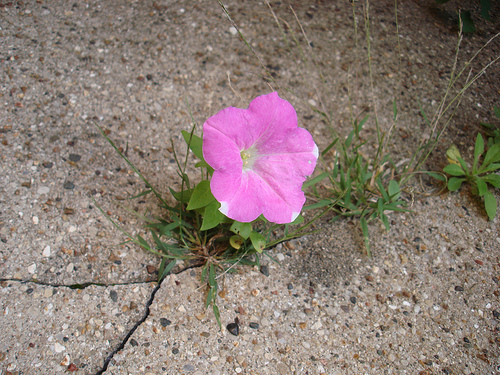
One hot summer day, like today, I was riding my bike around the campus of the University of Notre Dame. And as I was pedeling down the sidewalk, I saw something rather unusual. Out of a crack in the sidewalk grew a single bright red flower: a petunia.

It had gotten there for two reasons - number one: the gardener was careless. There was a flower bed nearby, but one seed had apparently fallen down that crack in the sidewalk. And number two: the seed managed to find rich soil deep down underneath the sidewalk.

Today's parable is about a careless gardener. The sower is throwing seed all over the place. He's throwing it on the path, on rocky ground and in the thorns.

Jesus is a careless gardener. He sows the seed of His word everywhere. He sends his word to anyone who has ears. He gives everyone a chance to hear his word. But will the seed of his word take root in us?

Today's Gospel is about the sower: Jesus; and the seed: His word; and us: the soil. There's another very important component in today's Gospel: the root system: our spiritual life.

Jesus describes four root systems. Notice how, as Jesus tells the parable, the root systems go from the very barren to the very fertile.

First, there's the path: the non-existent root system. The path is so hardened by the trampling of feet that there's not even a crack for the seed to penetrate. This is the non-existent spiritual life that opens no doors for Jesus to enter.

Second, there's the rocky ground: the shallow root system. In Palestine, there are sections of ground where large slabs of limestone are covered by only an inch or two of soil. There's no depth. This is the shallow spiritual life which gives up after difficulty and tribulation.

Third, there's the thorns: the polluted root system. There's a certain plant called the "strangler fig" which begins life nesteled in the branches of a host tree. It sends its roots down to the soil and as soon as they touch earth, it grows rapidly and envelopes its host, strangling it. This is the polluted spiritual life in which we give greater honor to things than to God.

Then, there's the rich soil: the healthy, cultivated and fertilized root system. The right environment for seed to take root.

If we don’t have a healthy root system, we won’t be nourished. And if we’re not nourished, we will eventually wither up and die. Our spiritual life is our root system. What goes into a healthy root system?  What is a healthy spiritual life made up of?

Every living creature, every animal and every plant, requires water for life. We receive new life though the waters of Baptism and we continue to be watered when we renew our baptismal promises to accept God and reject Satan, signified when we bless ourselves with water from the baptistery and actualized when we love God and our neighbor in thought, word and deed.

Every living creature needs food for growth. Our food is the Body and Blood of Christ and it gives us eternal life.

No matter how good the soil is, weeds always creep in. Why do we always struggle with this sin? Well, because their like weeds. Flower beds have an inclination, if you will, for weeds to grow. Likewise, we suffer from something called concupiscence, which is our inclination to sin. It doesn't mean we're evil. It means we need regular weeding where our sins are ripped out by the roots which happens in the Sacrament of Reconciliation.

Soil stays fertile through routine tilling, turning over, and fertilization. This is the life of prayer; daily maintenance where Jesus digs his hands into you and turns you over, forming you.

Plants and animals need the sun. One day when Monsignor was recovering from his heart surgery I found him sitting on a chair next to the patio door in the living room. I said, "What are you doing?" "Getting my Vitamin D!" he replied. He needed the sun for his health. You know how you feel when the permacloud of a Fort Wayne winter settles interminably over us. We get depressed for lack of the sun. Plants always turn to face the sun and they follow it throughout the day. Likewise, we need to turn and face the Son in Eucharistic Adoration. Facing the Son keeps us oriented toward him throughout the day.

And we need a farmer: Jesus Christ who plants, waters, tills, feeds you through his chosen instruments: parents, families, teachers, catechists, priests.

This is what a healthy root system, a healthy spiritual life, is comprised of.

A healthy root system is not comprised of a successful career, a solid 401K, or a strong portfolio. It is not an impressive resume. It is not the esteem of your friends and popularity. Nor is it the neighborhood or house you live in, the car you drive, the clothes you wear or the latest technology, or a built up sense of pride.

A healthy root system is your relationship with Christ. It is your willingness to allow the soil of your lives to be exposed and penetrated by Christ the sower. So let him cleanse and fertilize your soil. Amazing things will happen. He can even make petunias grow through cracks in the sidewalk.

Sunday, July 3, 2011

A New Birth of True Christian Freedom


Homily from the Fourteenth Sunday in Ordinary Time - Year A

I love the Fourth of July. One of my favorite figures of American History is John Adams. John Adams was probably more responsible for American independence and freedom than any other person in our history. He was short, fat, balding, obnoxious and loved to hear himself talk. I can relate to him in every way.


A couple of years ago, some of my brother seminarians and I went to Pennsylvania for fall break. We went to Philadelphia and visited Independence Hall where in 1776, in a small room not much bigger than this sanctuary, men such as Adams, Thomas Jefferson and Benjamin Franklin literally created the United States of America based on the idea that this nation should flourish in freedom.

We also visited Gettysburg where, for three days in the summer of 1863, approximately 50,000 Americans ended up as casualties in a great epic battle over whether or not our nation conceived in freedom could long endure.

And as I stood in the room in which our nation’s freedom was born and on the fields on which it faced its greatest test, I was filled with a tremendous amount of pride and gratitude for the freedom we enjoy, for which so many have given, and continue to give, their lives.

If you were to go up to someone on the street and ask them to define “freedom” they’d probably say something like, “Freedom is the ability to do whatever you want.” But I question the validity of that definition. Are we truly free, simply by doing whatever, whenever we want?

True freedom is choosing to do what is good for us and good for others and rejecting what is harmful to us and harmful to others. “The more one does what is good, the freer one becomes. There is no true freedom except in the service of what is good and just. The choice to… do evil is an abuse of freedom” which only makes us slaves… slaves of sin.

We all know that bad feeling inside when we fail to choose to do good, don’t we? When we give in to temptation and slip into sin, if we ask ourselves honestly, we have to say we do not truly feel free.

Imagine the freedom, the power you feel when you say to yourself: “I have the freedom to avoid indecent images on the TV or the internet. I am not a slave to pornography.” “I have the freedom to remain chaste before marriage and save myself for my future spouse and them alone.” “I have the freedom to not take a drink today, or use drugs. I am not a slave to addiction.” “I have the freedom to not eat 6 coney dogs at Coney Island.” That is true freedom. That is Christian freedom. I think this is the kind of freedom the patriots of 1776 and the men of Gettysburg fought and died for. At the very least, it’s the freedom Jesus Christ died for.

This true freedom is what Jesus is talking about in today’s Gospel when he says “my yoke is easy and my burden is light.” The yoke of freedom from sin is far lighter and easier than the yoke of slavery to sin. We labor under the yoke of sin and are heavily burdened. Jesus invites us to come to him, particularly in Confession, so that he may give us rest.

In his address at Gettysburg, Abraham Lincoln prayed that our nation, tested by the scourge of Civil War, would have a new birth of freedom. We too should pray and work for a new birth of freedom as well – a new birth of true Christian freedom; not just a psuedo-freedom to do whatever, whenever we want, but the freedom to live in virtue, free from the slavery of sin.

This new birth of true Christian freedom cannot be born in a small room in Philadelphia. It must be born here, in this Church where Jesus takes away our sins and feeds us with his Body and Blood. And this new birth of true Christian freedom cannot be fought for by someone else on the fields and farms of Gettysburg, Pennsylvania. We, empowered by the grace of God, must fight for it here in our fields and farms, on our streets and sidewalks, in our workplaces and our classrooms, in our hearts and homes and lives.

Sunday, June 26, 2011

Real Presence

Homily from the Solemnity of the Most Holy Body and Blood of Christ (Corpus Christi Sunday) - Year A

In 1992, a Gallup Poll of Catholics was conducted regarding the Real Presence of Jesus Christ in the Eucharist.  It showed that many Catholics do not understand what the Eucharist truly is.  30% of Catholics believed correctly that they are really and truly receiving the Body, Blood, Soul and Divinity of the Lord Jesus Christ under the appearance of bread and wine.  However, the remaining 70% of Catholics polled did not believe in the Real Presence.

29% of Catholics believe they are receiving bread and wine that symbolize the Body and Blood of Jesus.

10% believe they receive bread and wine in which Jesus is also present.

And 24% believe they are receiving what has become Christ’s Body and Blood because of their personal belief.

Not only that, but the problem increase dramatically among younger Catholics:

Age 65 and over …………… 51% believe in the Real Presence.

Age 45 – 64 ……………….... 37%.

Age 30 – 44 ……………….... 28%.

Age 18 – 29 ……………….... 17%.

Now granted, this poll was conducted nearly 20 years ago when, let’s face it, catechesis wasn’t as good as it is today.  And I’m going to guess that our teens today hold a much more convicted belief in the Real Presence of Jesus in the Eucharist.  When you see our teens kneeling in prayer before the Blessed Sacrament at Eucharistic Adoration, some of them in tears, you know they believe in the Real Presence.  People don't cry over bread and wine.
I’m fairly certain that, as a whole, we have a better understanding fo the Real Presence.  Nevertheless, I can’t help but assume that there are perhaps still many among us who do not understand and/or believe in the Real Presence of Jesus Christ in the Eucharist.  So, we’ve got some work to do.

How do we know, that what we are about to receive at Communion, is really and truly the Body and Blood, Soul and Divinity of Jesus Christ and not just a symbol?  We know it for two huge reasons:

1.) Jesus said so himself

2.) This is what the earliest Christians believed unanimously.

In today’s Gospel we hear a portion of Jesus’ “Bread of Life Discourse”, the Magna Carta of the Real Presence, from chapter six of St. John’s Gospel.  And we heard Jesus say, very clearly, “the bread that I will give is my flesh for the life of the world.” Jesus says that the bread he gives is his flesh.  He is saying that the bread he will give in the Last Supper and at all subsequent Eucharists is in fact, his flesh.

Now the usual objection is, “Jesus isn't speaking literally.  He is speaking only metaphorically, right?"  The answer is “no.”

Jesus is speaking literally.  And some of his disciples take him literally.  And they are shocked that Jesus would say such a thing.  They are, for lack of a better term, “grossed out” at Jesus’ suggestion that they eat his flesh.

So, they question the literalness of his statement.  They ask, “How can this man give us his flesh to eat?”

Then, instead of explaining to the Jews that there were misunderstanding him, that he was only speaking figuratively, Jesus – using the strongest possible language – emphatically repeats the literalness of his teaching, not once, but five times:

“Unless you eat the flesh of the Son of Man and drink his blood, you do not have life within you.”

“Whoever eats my flesh and drinks my blood has eternal life.”

Jesus says, “My flesh is true food and my blood is true drink.”  Not, “My flesh is symbolic food and my blood is symbolic drink.”

“Whoever eats my flesh and drinks my blood remains in me and I in him.”

“The one who feeds on me will have life because of me.”

And when the Jews can handle no more of this kind of talk, Scripture tells us that “As a result of this, many (of) his disciples returned to their former way of life and no longer accompanied him.”

And you know what Jesus does? He lets them go. He lets them walk away. He lets them leave him.

Now if Jesus intended the Eucharist to only be a symbol of his Body and Blood, why didn’t he call them back and explain that he is only speaking figuratively?  Because he has spoken literally, and because these disciples understood him literally.

Besides, if Jesus wanted us to encounter him only through symbols, why wasn’t the Cross enough?  Jesus could have said “Remember me when you see the Cross. Do as I instructed you when you see the Cross. Think of me and I’ll be thinking of you when you see the Cross.”  No. Jesus said, “This is my Body… this is my Blood.” And “I am with you always, until the end of the age.”  Jesus remains with us until the end of the age in the Eucharist.

You remember when Moses and the Jews were slaves in Egypt under Pharaoh; what they had to do to escape the 10th plague of death to the first born son?  They had to eat the Passover lamb.  If they wanted to live, they had to eat the lamb.

The Last Supper in which Jesus gave himself to the Apostles in the Eucharist was a Passover meal.  A New Covenant in which we are saved from the death of sin.  And we do so by eating the Lamb.

If we want to live, we have to eat the Lamb. Not a symbol of the Lamb, but the Lamb of God Himself.

We know, that what we are about to receive at Communion, is really and truly the Body and Blood, Soul and Divinity of Jesus Christ and not just a symbol, because Jesus said so.  And also because its what the earliest Christians believed.

The Apostles believed in the Real Presence  St. Paul said so in our second reading: “The cup of blessing that we bless,  is it not a participation in the blood of Christ? The bread that we break, is it not a participation in the body of Christ?”

And those who learned from the disciples, the Church Fathers, believed in the Real Presence.

St. Ignatius of Antioch, a disciple of St. John, said that some people “abstain from the Eucharist and from prayer, because they do not confess that the Eucharist is the Flesh of our Savior Jesus Christ.”

St. Justin Martyr from the 2nd century said, “not as common bread nor common drink do we receive these… [but] the Flesh and the Blood of that incarnated Jesus.”

St. Cyril of Jerusalem from the 4th century said, “Do not, therefore, regard the bread and wine as simply that, for they are, according to the Master’s declaration, the Body and Blood of Christ.”

But don’t take my word for it. Listen to this quote by a theologian who was writing at the time of the Protestant Reformation when the doctrine of the Eucharist began to be corrupted:

"Of all the fathers, as many as you can name... none of them uses such an expression as, 'It is simply bread and wine,' or, 'Christ’s body and blood are not present.' Yet since this subject is so frequently discussed by them, it is impossible that they should not at some time have let slip such an expression as, 'It is simply bread,' or, 'Not that the body of Christ is physically present,' or the like... actually, they simply proceed to speak as if no one doubted that Christ’s body and blood are present. Certainly among so many fathers and so many writings a negative argument should have turned up at least once, as happens in other articles; but actually they all stand uniformly and consistently on the affirmative side."

Those words were spoken by Martin Luther, who, during the Protestant Reformation, altered the Church’s understanding of the Real Presence of Jesus Christ in the Eucharist.

Which is more likely?  That Jesus would have said, “This is my Body and this is my Blood” and that’s what everyone believed, but were wrong until Martin Luther came along 1,500 years later and got it right?  Or, that Jesus said, “This is my Body and this is my Blood” and that’s what everyone believed and that’s what continues to be believed in the Catholic Church today because it is, in fact, true?

We believe in the Real Presence of Jesus Christ in the Eucharist.  It’s not a symbol.  I didn't give up a wife and children for crackers and grape juice.  It’s not Jesus cohabiting with bread and wine side-by-side.  It’s all Jesus, Body and Blood, Soul and Divinity, under the appearance of bread and wine.  And it’s not that way because you or I personally believe it to be so.  It’s that way because Jesus said so.

If we don’t believe Jesus is truly here in the Eucharist, then why bother coming to Church?  We don’t come here primarily for good music and powerful messages.  We don’t come here primarily for community and fellowship.  We don’t come here primarily to feel better about ourselves.

We come here, first and foremost, for the Eucharist.  And nothing else is even a close second.  We come here to the Catholic Church, because it (and the Orthodox Christian Church) is the only place on Earth where Jesus is truly and really present in the Eucharist.

Sunday, June 19, 2011

Communion of Persons

Homily from the Solemnity of the Most Holy Trinity - Year A

One of my seminary professors threatened my life once.  He said, “If I ever hear that on Trinity Sunday, you said in your homily that the Trinity is a “mystery” we can’t understand and say nothing more, I will hunt you down like the dog that you are and destroy you!”  He lives only three hours away, so I never know when he might sneak into the back pew so here goes.

My dad loves to golf.  He’s one of those guys, if you ask him what he did five minutes ago, he doesn’t have a clue.  But you ask him how his round of golf went and he knows every single shot from memory.  After a great round he can’t just keep it to himself.  He has to tell someone about it.

I love the movies.  Whenever I see a great movie, the first thing I do is I gotta tell someone else about it.

Same thing with food.  When you take a bite out of something amazingly delicious, what’s the first thing you say to the person sitting next to you?  “You touch my food and I’ll stick this fork in your ribs.  Hopefully not. I think most normal people say, “Oh my goodness this is so good; you’ve got to try this.”

We have a natural inclination to want to share the things we love.  “You’ve got to read this book.”  “You’ve got to go to Arizona.”  “Let me introduce you to my mother-in-law.”

OK, maybe not that one.

That’s the nature of love.  Love cannot remain in isolation.  The nature of love is that it must be shared; it must be given to another.  Love “unbottles” itself as it were.

That’s the nature of God too.  After all as the Gospel of John states, “God is love.”  God cannot remain in isolation.  The very nature of God is that He must share Himself; He must give Himself to another.  God “unbottles” Himself.

And He does this in so many ways, but today, let’s consider two.  First, God unbottles Himself within Himself.  If God is love, He would not make sense if He were alone, so to speak.  So He isn’t alone.  God is such a perfection of unbottled, unbridled love that He isn’t just one Person, He’s three: Father, Son and Holy Spirit.  God is a communion of persons. A communion of love.  God shares Himself, He gives of Himself, and He loves Himself within Himself; among the three Persons of the Trinity.

St. Augustine said that whenever you have love, there’s a lover, there’s the one who is loved, and there’s the love that exists between them.  He’s talking about the Trinity.  First there’s the lover: God the Father.  Then there’s the one who is loved: God the Son.  Then there’s the love between them: God the Holy Spirit.

Second, God unbottles Himself with us.  God is perfect.  There is nothing you can add to God to make Him a better God.  Yet, in his infinite wisdom and love, having no need for us, God created us out of love and shares His love with us. 

God shares this love with us most perfectly by making a gift of Himself to us through His Son, Jesus Christ.  Our Gospel today says, “God so loved the world that He gave His only Son.”  And God continues to show us His love through the gift of the Holy Spirit.

And not only does God reveal Himself to us as love through His being a communion of persons – a Holy Trinity; He inscribes His divine nature into us.  For we are created in His image and likeness.  We’re not just created in the image and likeness of God the Father.  We’re created in the image and likeness of the Father, Son and Holy Spirit.  We’re created in the image and likeness of the Holy Trinity – a communion of persons.  And so we’re created to be a communion of persons ourselves – with one another and with God.  We’re created for love.

That’s the greatest desire of the human heart isn’t it?  We all desire to be loved.  And we equally, if not more so, desire to give love.  Of course!  It’s how God made us.  He made us for entering into communion with one another and with Him.

This, of course, is realized so profoundly in marriage.  When husbands and wives enter into communion with one another.  You have the lover and the one who is loved.  And the love between them, by nature, becomes “unbottled” and literally becomes a third person, a child conceived in love.  You could say that the family is an icon, an image of the Holy Trinity. 

On this Father’s Day, I want to exhort the father’s among us to follow our Heavenly Father’s lead and seize the opportunity to be the initiator of love within your family.  I’m sure you’re well aware that the divorce rate in our country is 50%.  There’s a cure to such a disease and it’s found in the communion of persons.  When couples choose to enter into communion with the Holy Trinity and with one another, their chances of having a lifelong marriage skyrocket.

There have been numerous studies that show that families that pray together stay together.  Yes, the national divorce rate is 50%.  But, when couples are married in the Church or another place of worship (and return there weekly) to enter into communion with God, the divorce rate is 1 out of 100.  And, when couples pray together in their home, for just a few minutes everyday, the divorce rate is 1 out of 1,000.

A priest once told me that when couples come into his office and their marriage is on the rocks, he tells them they need to get Jesus at the center of their marriage.  So he tells them that he wants them to hold each other’s hands for just a few minutes a day and they are to pray together.  And they're not allowed to say Our Father’s, Hail Mary’s and Glory Be’s.  He’ll ask them if they can do this.  Of course, they say “yes.”  Then he’ll say, “OK, do it now.”  And their shocked right? They’ve been put on the spot.  And he says to them, “I didn’t just ask you to walk 100 miles. Pray together.”

Because one of the biggest obstacles to prayer is simply getting over the awkwardness of prayer.  The thing is – you just have to get over it.

So dad’s here’s what I want you to do.  Tonight, I want you to take your bride’s hands into yours and I want the two of you to pray together.  I want the two of you to enter into communion with one another and with God.  When a woman who loves God sees that kind of love and vulnerability in her husband – look out! Wow, will she fall in love with him!  And if things are kind of rocky between you (or really rocky between you) then you know how much you need Jesus there with the two of you.

“Unbottle” your love for one another and for God.