Wednesday, September 29, 2010

VincentFest & VincentFast


Homily from the 26th Sunday of Ordinary Time - Year C


I have a friend at my old seminary, the Josephinum in Columbus, Ohio. He is from Burma: a tiny, poor country in Asia. His name is Saw Francisco.

Saw Francisco is the happiest guy in the seminary. In all the time I spent with him, not once did I ever see Saw Francisco angry, cross, agitated or frustrated. I’ve never seen him lose his temper. Saw Francisco always, always has a smile on his face; always offers a friendly greeting and asks how you are doing.

One day, a bunch of the guys were hanging around and someone asked Saw Francisco what he would miss most about the seminary. Saw smiled and said, “Two things: my bed and hot water.”

Everyone just kind of froze when they heard this. I think a couple jaws dropped a bit… eyes widened. And we quickly realized how different our lives are from Saw Francisco’s and so many other people around the world.
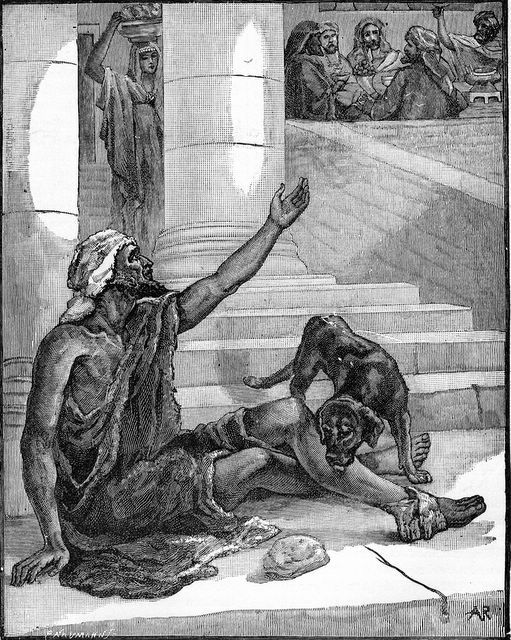
We often forget the poor. In today’s Gospel, Jesus tells us about the rich man who dressed in the finest clothes and ate the finest foods every, single day. While Lazarus, a sick, poor, starving man lays at his doorstep. When these men die, Lazarus goes to Heaven and the rich man goes to Hell.

Why did the rich man go to Hell? Was it because he was rich, or because he had the finest clothes and the finest food? No. Pope John Paul II said of this Gospel, “Nowhere does Christ condemn the mere possession of earthly goods as such. Instead he pronounces very harsh words against those who use their possessions in a selfish way, without paying attention to the needs of others.” (Homily in Yankee Stadium, 2 October 1979.) The rich man went to Hell, not because of his riches, but because he ignored the poor man, Lazarus.

Jesus tells us that Lazarus would gladly have eaten of the scraps that fell from the rich man’s table. In those days, there were no such things as napkins. So the very wealthy would wipe their hands clean with pieces of bread and throw them onto the ground. These are the scraps Lazarus would have gladly eaten. But Lazarus does not get so much as a scrap because the rich man ignores him.

We must not forget our brothers and sisters who have no bed, no hot water, no food, no job, no clothing, no home, no one to love them or pray for them. We who have so much, must be ever mindful and ready to help those who have so little. The Second Vatican Council reminds us of this obligation in its document, Gaudium et Spes which states, “Everyone must consider his every neighbor without exception as another self, taking into account first of all his life and the means necessary to living it with dignity so as not to imitate the rich man who had no concern for the poor man Lazarus.” (G&S 27).

And we, above all people; and at this time, above all other times, should be mindful of the poor. For this weekend, we celebrate the feast of our patron Saint: Saint Vincent de Paul who dedicated his entire life to imploring the wealthy to give generously of their resources for the sake of the poor. We’re familiar with this work of St. Vincent de Paul for the poor; he also ministered to condemned prisoners who would lay on damp dungeon floors, while they were covered with vermin and sores, whose only food was black bread and water. Sounds like Lazarus doesn’t it?

St. Vincent de Paul the man did not forget the poor. And St. Vincent de Paul the parish will not forget the poor.

We will be mindful of the poor through the three acts of penance: prayer, almsgiving and fasting. We will be mindful of the poor in our prayer at this Mass. We will be mindful of the poor in our second collection today which is for the St. Vincent de Paul Society. And we must be mindful of the poor through fasting.

Fasting is not just something we do during Fridays in Lent. As Catholics we are to offer some form of penance every Friday of the year: be it abstaining from meat, or fasting from a meal, or walking the stations of the cross, or praying a rosary. (Code of Canon Law: #1249-1253).  We do this every Friday because we offer it as a penance for our sins to Jesus who gave his life for us on Good Friday.

And we offer it, not just to deny ourselves of too much food, or drink, or pleasure; but also so that we may be in communion with our brothers and sisters who do not have what we have.

This doesn’t mean, we cannot enjoy the good things we have. Jesus wants us to relish his gifts which we have received from his bounty. Jesus wants us to have feasts. That’s why days that honor Jesus, Mary and the Saints such as today are called feasts; because Christians would celebrate these days with feasts. And that’s what we're doing this weekend at our VincentFest (Fest by the way, means feast). We will enjoy good food and good company.

We Catholics are feasting people. We’re also fasting people. So this weekend, let us observe VincentFest. And this Friday, let each of us observe a VincentFast.

At this Mass, pray about how you want to fast this Friday as a way to be in communion with our poor brothers and sisters around the world; then when you go home, write it down on your calendar so you won’t forget. Maybe you’ll abstain from meat. Maybe you’ll skip a meal. Maybe you’ll fast from your bed and sleep on the floor Friday night. Maybe you’ll fast from hot water and take a cold shower Friday morning.

We will not ignore our poor brothers and sisters lying at our doorstep. May this Eucharist inspire us to spend a moment this Friday to live in communion with them.

Sunday, September 19, 2010

"The Ball Was Here... and it Rolled to Here."


Homily from the 25th Sunday of Ordinary Time - Year C

This past Thursday, something happened at a baseball game that unfortunately is not uncommon; and even more unfortunately, is regarded less and less today in our culture as a problem and instead is seen as “part of the game.” The New York Yankees were playing the Tampa Bay Devil Rays. Both teams are neck and neck in a race to win the American League pennant and the Yankees were down by a run. Derek Jeter was at the plate for the Yankees and took a pitch that appeared to hit him in the wrist. Jeter yelled in tremendous pain, jumped up and down clenching his arm. He even went over to the team trainer to have his arm checked out. He was ruled as being hit by the pitch and was awarded a free base. So Jeter went to first.

However, the instant replay clearly showed that the ball didn’t hit Jeter at all. Rather, it hit the knob of the bat.

Afterwards, Jeter was asked by a reporter in the locker room where the ball hit. Jeter readily and unapologetically said, “The bat.” Then he said, “What can you do? My job is to get on base.”

A reporter wrote that “batters often try to pretend they’re hit by pitches that just miss; it’s something they’re taught to do.” People will say, “Oh, it’s just part of the game.” Really? Cheating is part of the game? Maybe its been a part of the game, but that doesn’t make it right.

If we teach our children that it’s OK to reach first without merit, what are we teaching them? Are we teaching them that “As long as you don’t get caught, it’s OK”?

Jesus tells us today, “The person who is trustworthy in very small matters is also trustworthy in great ones; and the person who is dishonest in very small matters is also dishonest in great ones.”

I don’t know if you’ve noticed this, but there’s been a lot of cheating in baseball recently. Nearly every big hitter in baseball over the last decade has admitted to, or is strongly suspected of, using illegal drugs to give themselves an unfair advantage.

I don’t think anyone jumps from being squeaky clean to using steroids. Just as no one goes from being pure of heart to being an adulterer. Big sins don’t just show up. Everything starts off small. And uncorrected, sin grows and grows and grows.

If we allow ourselves to “skim a little off the top,” what are we training ourselves to steal next? If we say, “Its O.K. to look, but not touch,” how long will it be before the look no longer satisfies and what will we seek next?

There’s a book called, “Don’t Sweat the Small Stuff.” You know what? I think we need to sweat the small stuff. Because (and you’ve heard this phrase before and its true) it’s the little things that matter.

Mother Theresa once said, “If we deliberately allow venial sin to become a daily bread, a moral anemia, the soul becomes weak all around, the spiritual life begins to crumble and fall apart. God preserve us from any deliberate sin, no matter how small it may be. Nothing is small when it means going against God.”

There’s a great scene in a favorite movie of mine that illustrates the right thing to do when tempted with, what seem to be, only very small matters. The movie is “The Legend of Bagger Vance” and it’s a fictional story about a golfer named Junuh who climbs out of the dumps and is given the chance to play against the two best golfers of his day: Walter Hagen and Bobby Jones. And Junuh, unexpectedly takes a one shot lead heading into the 18th hole. There’s only a couple shots to go and Junuh will win the match.

So Junuh is lining up his approach shot to the 18th green, and he sees a tiny twig lying close to the ball and he reaches down to move the twig so he can have a clear shot. And as he pulls the twig away, the ball moves… about a half an inch.

Junuh freezes and mutters, “The ball moved. It moved. I have to call a stroke on myself.” No one else saw the ball move but Junuh, his young caddy Hardy, and his coach Bagger Vance.

Hardy pleads with Junuh, “No! Don’t do it! Please don’t do it. Only you and me seen it and I won’t tell a soul. Cross my heart. Ain’t nobody gonna know!” Junuh replies, “I will Hardy. And so will you.”

Hardy runs to Bagger and begs him, “You’ve got to tell him not to do it, Bagger! It’s just a stupid rule that don’t mean nothin’” And Bagger says, “That’s a choice for Mr. Junuh, Hardy.”

No one wanted the penalty assessed, not even Junuh’s opponents. Bobby Jones says, “Maybe you’re mistaken Junuh. Maybe the ball moved before you touched the twig.” Walter Hagen says, “Might not have moved at all. The light plays funny tricks this time of day.” Everyone is giving Junuh the opportunity to avoid the penalty.

And the field judge reads the rule: “A ball is deemed to have moved if it leaves its original position in the least degree, but not if it merely oscillates and comes to rest in its original position. Did it move? Can you be certain? Sometimes a ball will shudder and then settle back again, Junuh.”

Junuh answers, “The ball was here… and it rolled to here.” The distance the ball moved was so very little... a very small matter. But Junuh’s duty to play by the rules, to not resort to cheating, to do what was right, was a very great matter indeed. It's a very great matter for all of us.

Sunday, September 5, 2010

"All In!"


Homily from the 23rd Sunday in Ordinary Time - Year C

Quite frequently, on a Friday or Saturday night in the seminary, the guys will get together for a game of cards.  A lot of guys like to play Euchre.  But the most popular game they play is probably No Limit Texas Hold Em.  You’ve probably seen it on TV, it's wildly popular right now.  It's a version of poker played with chips and the player who is holding all the chips at the end of the game is the winner.

One of my buddies from the seminary, Father Andrew Trapp, a priest from the diocese of Charleston, South Carolina, got so good at Texas Hold ‘Em, he appeared on a poker game show a few months ago and played for charity against the top professional poker players in the country.

Now most people, when they first start playing poker, they play their chips very conservatively.  They place small bets because they don’t want to lose their chips.  The problem is, if you play scared, and make timid bets the whole time, you’ll never win, you’ll never rake in a big pile of chips.

If you want to be a successful player of Texas Hold ‘Em, you have to be willing to take a big risk every now and then.  You have to be willing to go “All In!”  That’s when you bet everything you have.  You shove all your chips into the center of the table and say “All In.”  Then, if you have the better hand, you win the whole pot.

See the YouTube of Fr. Trapp going "All In!"
This is what my buddy Father Trapp did. We were watching the show on TV and he’s playing against Daniel Negreanu, who is one of the absolute best poker players in the country.  Father Trapp wasn’t holding an outstanding hand, but he took a risk and he shoved all his chips into the middle of the table and declared “All In!”  The pro’s eyes got really big.  He was a like a shark who smelled blood in the water.  He wanted to take all of Father Trapp’s chips so he went all in too.  However, when the cards were laid down on the table, Fr. Trapp had the better hand and he beat the world pro and won $100,000 dollars which he donated to his Church building fund.  God was on Father Trapp's side!

Jesus wants us to go “All In!”  He tells us in today’s Gospel that if we really want to be his disciple, we have to give him everything.

In fact, he even uses some pretty harsh words.  He says, “If anyone comes to me without hating father and mother, wife and children, brothers and sisters and even his own life, he cannot be my disciple.”

Now, you have to understand that Jesus is using a figure of speech here.  He doesn’t want us to really hate our family.  I mean, how much sense would it make for us to love our enemies but hate our family and friends?

Jesus is saying that as much as we love our families, we must have a love for him that is on an whole another level.  We must have an absolute love and preference for Jesus above all other things, above all other people, above even our own lives and preferences.

And this is not an unreasonable expectation, because Jesus does the same for us.  Jesus was asked by his own Father, to be obedient to his Father’s will above all other things, even his own life.  So Jesus left everyone he knew behind – his disciples, his mother.  He took up his cross and gave his life to the Father for us.  He went “All In!”  He did this, because it was the very thing, the only thing, that would bring us happiness.

If someone goes out for a sports team, they are expected to give it all they’ve got so we can win the big game.  If someone signs up for the armed services, they are expected to commit themselves completely for the defense of our nation.  When a man and woman enter into marriage, they are expected to enter into an unbreakable bond that lasts all the days of their life. 

Now if we’re willing to commit ourselves so strongly to sports teams and the armed services which are worldly institutions, how much more should we commit ourselves to God?  Worldly institutions such as these last only for a period of time.  Even marriages last only “all the days of our life?”  How much more should we commit ourselves to the one who is offering us eternal life in Heaven?

Jesus says, if you don’t go all in, if you don’t come after me with all your heart, all your soul, and all your mind, you’ll look foolish like the guy who starts to build a tower then halfway through runs out of resources and is stuck with something that is only built halfway.

Jesus offers us eternal life by committing himself completely to us.  So he embraced his cross and gave us his life.

Jesus asks us to receive eternal live by committing ourselves completely to him.  So we must embrace our cross and give him our life in return.

And guess what, our crosses are not easy, they are heavy.  You can’t carry your cross with one hand.  You have to embrace it with both hands and it requires all the strength you can muster.

And our crosses shouldn’t be easy either.  Because our lives are not cheap; we have infinite value.  And Jesus purchased us at a great price.  So, it is only just that we give back to him, a worthy offering that requires great sacrifice on our part.

So, we’ve got a number of questions to ask ourselves:

“Do I really want to share the eternal life Jesus offers me from his cross?”

“Do I really want to be his disciple and put him above all other things?”

“Am I willing to embrace my cross, and willing to follow all that Jesus teaches through his Church?”

“Do I give Jesus my entire life? Or, am I playing scared and making a timid offering of myself?”

“Am I willing to go ‘All in’?”

Sunday, August 29, 2010

Humility - Who I Really Am In Relation To God

Homily from the 22nd Sunday in Ordinary Time - Year C

Last night, as I wrote my homily, I decided to put in a movie... "Rudy."  Hey, it was Saturday, the temperatures have started to drop and that means its college football season.  But there weren't any games on TV.  I had to get my fix.

Actually, I put in "Rudy" because the Gospel today reminded me of a great line from the movie.  It's from a scene where Rudy is facing his last chance to get accepted into Notre Dame and he's sitting in Church with Fr. Cavanaugh, a priest who's taken Rudy under his wing.  Rudy is desperate and he asks Fr. Cavanaugh if there's anything he can do.  Fr. Cavanaugh replies, "Son in 35 years of religious studies, I've come up with only two, hard, incontrovertible facts: there is a God... and I'm not him."  What a great statement of humility.

Today's readings are about humility.  In the Gospel, Jesus tells us to avoid seeking places of honor; instead seek the lower place.

The word "humble" comes from the Latin word "humus" which means "earth," "soil," or ground."  If you've ever eaten the food humus, you may have noticed that it looks like dirt or sandy-colored mud.  That's one way of understanding humility - to be lowly like dirt.

However, I think a fuller meaning of the word humble means to know who you really are in relation to God.  That's what Fr. Cavanaugh's quote is all about.

If you want to know who you really are in relation to God, read Genesis 2:7.  It begins, "The Lord God formed man out of the clay of the ground..."  Sounds like our Latin definition of humble doesn't it?  The clay of the ground... humus... earth, soil, ground.

But verse 7 continues: "and [God] blew into [the man's] nostrils the breath of life, and so man became a living being."

Being humble is not acting as though one were dirt.  Rather, being humble is understanding that without God, that's all we are: dirt.  Without his breath of life within us, we are just clay of the ground.  That's what it means to know who you are in relation to God.

Successful people are often called "self-made men."  That's a very dangerous way of looking at oneself.  None of us are self-made.  We are God-made men and women.  Everything we have comes from Him.  Everything we achieve is because of Him.

We should take time today, and everyday, to understand this; to be humble.  To take a look at ourselves for who we really are, which we will only see when we look at ourselves in relation to God.

How do we do this?  Do what the people who are dining with Jesus in today's Gospel do: "the people there were observing [Jesus] carefully."  Observe Jesus carefully.  Observe, especially, Jesus' humility.

Observe Jesus' humility in the manger at Bethlehem.  The Son of God lowered himself to become a helpless infant born of a poor carpenter and a teenage mother; and slept in a manger where animals feed, so that he would become the food of mankind.

Observe Jesus' humility in his childhood at Nazareth.  The Gospel of Luke tells us that Jesus was obedient to Mary and Joseph.

Observe Jesus' humility in his baptism.  He had no need of sacramental grace.  But nevertheless, he wanted to show us the first step of our salvation.  So he stood on the shore, side-by-side with sinners.

Observe Jesus' humility at the Last Supper when he took off his outer garment and wrapped a towel around his waist and did the work of a slave as he washed the dirty feet of his own disciples.

Observe Jesus' humility in his passion and death when the King of Kings, the Savior of the World, though he did no wrong, accepted our wrongs unto himself so that we might be saved.

Observe Jesus' humility here at this Eucharist when he makes himself truly present to us under the appearance of the humble elements of ordinary bread and wine.

And let Jesus observe you, just as he observed the guests at the banquet.  He was "noticing how they were choosing places of honor at the table."  Let Jesus observe you in every moment of every day.  Let him see you in your grace-filled moments and let him see you in your moments of pride and arrogance.  It's in those moments, our moments of weakness, when we become aware of his presence, that we realize how foolish our pride and arrogance are.

In a few moments, we will have the opportunity to observe Jesus and allow him to observe us when his Body and Blood are lifted up before us; when he, who was humbled so much for our sake, is exalted.  And we will say, as we kneel humbly before him: "Lord, I am not worthy to receive you, but only say the word and I shall be healed." 

Another way of understanding this response is "Lord, without you, I am but dirt; but only breath into me your Spirit of life, and I will be humbled.  I will know who I really am in relation to you."

Sunday, August 15, 2010

Everything That Comes Down Must Go Back Up

Homily from the Solemnity of the Assumption of the Blessed Virgin Mary

You’ve heard the phrase, “Everything that goes up must come down.”  It’s very true.  Phil Mickelson blasts a tee shot and it comes down 300 yards or so later.  Planes take off only to eventually land.  Even satellites that are launched into orbit eventually fall into disuse and drop back down to Earth burning up in the atmosphere.

It’s a very “earthy” statement: “everything that goes up must come down.”  It speaks about one of the ways in which the world works: the law of gravity.  But it’s not the way God works.  In fact, with God, you might say the opposite: that with God, “Everything that comes down must go up.”

Today, as we celebrate the Assumption of the Blessed Virgin Mary, we see an amazing example of how God works: how everything that comes down must go up.  Mary, upon completion of her life on this lowly earth, was taken up body and soul into Heaven.  She, who was born without the stain of Original Sin, would not experience the bodily decay of death.  She was not a typical fallen human being.  Rather, she was “full of grace” as the Archangel Gabriel proclaimed at the Annunciation.  Mary is the perfect creation of God.

How many times when we mess up and sin do we say, “Oh, that’s just human nature.”?  Well, in reality, while we do have the tendency to sin, sinning is not our true human nature.  In fact, there is nothing more inhuman than sin.  It’s not the way God created us.

Rather, it is the result of the fall of man, the sin of our first parents: Adam and Eve.  Before the Fall, before Adam and Eve disobeyed God by listening to Satan instead of our Father, before Original Sin, Adam and Eve were created with Original Grace.  Like Mary, they too were born without Original Sin and could have lived free from sin.  That was God’s original plan for mankind.  But in their disobedience, Adam and Eve, and all of mankind with them, fell.  But it will not be this way forever.

As we heard in our second reading: through Adam, death entered the world. But through the second Adam, Jesus Christ, the resurrection entered the world.  Just as in Adam all die, so too in Christ all shall be brought back to life.  The law of our fallen world states that “everything that goes up must come down.”  

But the New Law of Jesus Resurrected reads “everything that comes down must be raised up.”  Our second reading also states that all will be brought back to life in their proper order: first Christ, then those who belong to Him.  Well, who belongs to Christ more than His own mother, Mary.  So, in Mary’s Assumption into Heaven, we see the first evidence of God’s promise to all of us, fulfilled.

In a few moments, as we pray the Eucharistic Prayer, we will proclaim Mary as “the beginning and pattern of the Church.”  We are the Church.  So Mary shows us the beginning and pattern of our destiny.  Those who belong to Christ, will see the resurrection of their own bodies on the Last Day.  Her Assumption is a sign of our destiny: resurrection from our earthbound graves up to our Father in Heaven.   Everything that comes down must go back up again.

My Canon Law professor, Sister Elizabeth McDonough, told us that if we did only one thing before we were ordained priests, we should read the last chapter of Lumen Gentium.  Lumen Gentium is the Second Vatican Council’s document on the Church and the last chapter is about Mary, which is appropriate since, as the Mother of Jesus, she is the Church’s first member and model. 

In that chapter, two qualities of Mary are repeated over and over again and they are qualities we should imitate.  The first, is Mary’s perfect obedience to our Father, exemplified so beautifully at the Annunciation, when Mary said “yes” to the Archangel Gabriel and obeyed God’s will that she be the Mother of Jesus.

The second, is Mary’s perfect union with Jesus; in her giving birth to Him, by being His first disciple and the first member of His Church, and by persevering with Him throughout his life even to the point of having to stand at his Cross to watch Her own Son be crucified and die.

And in both of these: Mary’s obedience to our Father and her union with Jesus, we see Mary’s humility.  In the Gospel, Mary calls herself God’s lowly servant.

Humble people are often called “down to earth.”  But today, Mary shows us that the humble are really more appropriately described as being “up to heaven.”

If we imitate Mary’s humility, her obedience to the Father and her union with her Son Jesus, all of us, who have fallen down will rise back up again.

Sunday, August 8, 2010

Football Season Is Coming! Get Ready For Jesus

Homily from the 19th Sunday in Ordinary Time - Year C

Since arriving at St. Vincent’s, my "joy-meter" has been operating at about 90% capacity or higher.  I love being a priest and I especially love being a priest here at St. Vincent's.

But this past week, the "joy-meter" made a huge jump.  Last Wednesday at about 5 o'clock, I was driving down Auburn Road and I saw the St. Vincent's football team practicing.  I immediately got excited.  I love football and can't wait to see our team play.

Then, the next day, I was out driving again and the "joy-meter" shot up to about 150% when I saw the Bishop Dwenger football team practicing.  I stopped by practice, told the guys I was praying for them and asked them to pray for me.

Our teams are running drills, learning their positions and executing their plays.  They’re preparing… they're getting ready

In the Gospel today, Jesus tells us to be ready for His coming.  "Gird your loins," he says.  What in the world does that mean?  Well, in first century Palestine, men wore long robes and girding your loins was to hike up your robes a bit and cinch them with your belt so you could move about more freely and work.  "Gird your loins" is kind of a first century way of saying, "Roll up your sleeves."

And Jesus says, "light your lamps."  That's kind of a first century way of saying, "Keep your eyes peeled."

When we think about getting ready we tend to think that means doing a lot of stuff.  For example, when you go on vacation, you pack your bags, get your trip mapped out, fill the tank with gas and have a neighbor pick up your mail.  Or, like the football team; they're running drills, learning their positions and executing plays.

So, if Jesus wants us to be ready for His coming, what should we do?  This answer may sound dumb, but I’ll throw it out there anyway:  all you have to do to be ready for Jesus, is just be ready for Jesus.

Find this book on Amazon.com.
I'm reading a book right now called, "The Jesuit Guide to Almost Everything: A Spirituality for Real Life" by Father James Martin.  One of the things he talks about is being ready for a relationship with God and with Jesus  He talks about when he first entered the seminary and wondered what he had to do to be ready for God.  His spiritual director said, “Nothing. God meets you where you are.”

Sometimes we fall into the trap of thinking “I have to be super-holy in order to have a relationship with Jesus.”  That’s like saying “I have to lose 20 pounds before I can start my diet.”  It doesn't work that way.  Going on the diet helps us lose 20 pounds.  Having a relationship with Jesus that continues to grow is what makes us Saints.

Father Martin says, “Jesus often calls people to conversion, to cease sinning, to change their lives, but he doesn’t wait until they have done so before meeting them. He enters in relationship with them as he finds them. He meets them where they are.  Your spiritual house does not need to be tidy for God to enter.”

He goes on, “In the Gospels, Jesus often meets people in the midst of their busy lives: Peter mending his nets by the seashore, Matthew sitting at his tax collector’s booth. Just as often he encounters people when their at their absolute worst: [like the] adulterous woman about to be stoned.”

Now that doesn't mean that Jesus meets us where we are and stays there with us.  It means that Jesus meet us where we are and lifts us up into his life of light, truth and virtue. 

It means is that Jesus comes to us just as we are, right now, today, to have that relationship with us.  The only thing we have to do is be ready to greet him when he comes and to be ready to do His will.  In other words, we only have to have our eyes peeled, ready to recognize him when He comes, and our sleeves rolled up ready to do what he wants us to do.

You don't have to wait to "become holy" before going to Confession.  Confession is what helps you become holy.

You don't have to wait to become a veteran of prayer before having a deep conversation with God.  God wants to talk to rookie prayers

We're just like those St. Vincent's and Bishop Dwenger football players.  Some are veterans and have been playing for years.  And some are rookies, playing for the first time in their lives, and don’t know much about football yet.  But guess what, they’re all on the team

They made the team by girding their loins: putting on the pads.  And they made the team by lighting their lamps: listening to their coaches.

They’re ready for practice.  Are we?

Sunday, August 1, 2010

Aggressively Self-Giving

Homily from the 18th Week in Ordinary Time - Year C

A schoolteacher asked her English class what part of speech the word "mine" was.  The answer she was looking for was possessive pronoun.  A student raised his hand and answered "Aggressive pronoun?" 

The young student wasn't entirely wrong.  Words like "mine" can be used aggressively.  Focusing on the self makes us aggressively self-centered.

Jesus tells a parable about a man who is aggressively self-centered.  Listen to how many times the man uses the words, "me," "myself" or "I":

"What shall I do?  For I do not have any space to store MY harvest.  This is what I shall do, I shall tear down MY barns and build larger ones.  There I shall store all MY grain and other goods.  Then I shall say to MYSELF... eat, drink and be merry."

This guy is a real piece of work.  The only person he cares about is himself.  He is aggressively self-centered.

In the gospel today Jesus warns us, "Take care to guard against all greed."  Notice however that Jesus does not say that being rich is bad in itself.  Jesus says, "One may be rich."  Jesus is warning us not about our riches in and of themselves, but about our attitude about our riches.  Our lives do not consist of possessions.

This past week, a large number of youth from around our diocese saw an example of a good attitude towards material goods.  On Wednesday, our parish hosted an XLT (which stands for "Exalt!") an hour of praise and worship music and Eucharistic Adoration where dozens of teens knelt around the sanctuary worshipping Jesus in the Blessed Sacrament in a monstrance on our altar.

Immediately following the XLT, a family from our parish invited all the teens to their house for some refreshments.  So, we all went over, enjoyed some snacks and sodas, played some card games and enjoyed some good fellowship. 

This family had chosen to be the opposite of the man in the parable.  Rather than horde their possessions, they chose to share the blessings they had been given with others.

And as I walked around the house, I noticed something.  I noticed a Crucifix on the wall.  Then I noticed a picture of Mary on another wall.  And a picture of a Saint on another wall.

Then my eye caught the father's den where he had his bookshelves.  And as I perused his books I saw books about economics, planning your financial future, how to be successful with your money.

But right next to these books about money I saw the Catechism, the Bible, books about the Catholic faith, Jesus and the Saints. 

And it became apparent to me that this family's relationship with Jesus formed their attitudes toward their material goods.  It makes perfect sense that they would extend their generosity to the teens immediately after an hour of Eucharistic Adoration.  An hour in which we looked upon the ultimate example of generosity: Jesus' total gift of self in the Eucharist.

We often ask ourselves this question: "What is the meaning of life?"  I won't claim to have the answer completely, but I think it's something close to this: our lives only have meaning to the extent that we give of ourselves to others.  At the Second Vatican Council, the Church put it another way in the document Gaudium et Spes.  It says that "man only discovers himself, by making a sincere gift of himself," imitating Jesus' total gift of Himself to us in the Eucharist.

In a few moments, we will receive this gift again when Jesus Himself says, "This is My Body... this is My Blood... given up for you."  And as we receive this gift, we should ask ourselves: "How is Jesus calling me to make a gift of myself?  How do I use the blessings He's given me?  Do my possessions and my wealth drive me to be aggressively self-centered?  Or, do they inspire me to imitate Christ and be aggressively self-giving?"