Before entering seminary, I worked in advertising. One of my clients was a home security system company and one of the employees told me an interesting fact: over 90% of alarm systems are installed after a house’s 1st break-in. Most people don't think about security until after their security is violated.
If you’ve ever had your house broken into, you know how sickening a feeling it is. A few years ago, my dad asked me to check on his house and bring in the mail while he was on vacation. One day I drove up and saw that the front door was busted open. The lock had been broken, pieces of the door were splintered off and laying on the floor. Then I went upstairs and one of my dad’s file cabinets was pulled open and documents were thrown everywhere.
A burglary like that can leave you with a very foolish feeling and you find yourself making "If only" statements: “If I had only picked up the mail everyday.” “If I had only gotten an alarm system.” “If I had only deadbolted the door.”
Today we are cautioned to be awake and alert for Jesus’ coming. Don’t be caught off guard. Jesus likens the surprise of his arrival to the unexpectedness of a burglary. If the master of the house had known when the burglar was coming, he would not have allowed his house to be broken into.
Every Advent when we think of the coming of Jesus, we tend to think of his coming at Christmas But this is only his 1st coming. Today’s Gospel warns us to be prepared for the 2nd coming of Jesus at the end of time.
We should be prepared to meet the Lord as though he could come at any moment. Because that’s precisely how he will come – at any moment. He could walk through that door right now. Are we ready to meet him?
One way we can be prepared to meet the Lord at any given moment is to begin the day with a spirit and attitude of readiness for the Lord. One of my favorite Saints is St. JoseMaria Escriva who espoused something called the heroic minute. The heroic minute is that moment you wake up in the morning. And instead of hitting the snooze button, you wake up and get out of bed immediately, ready to serve the Lord and dedicate the day to him.
St. JoseMaria Escriva says, as soon as we wake up we should say the word, “Serviam” which is Latin for “I will serve!” Now, I have to admit, when I woke up this morning, I didn't shout "Serviam!" with glee. It was more of a mumble. One of my spiritual directors once told me that there are two kinds of people in this world: those who say, "Good morning Lord!" And those who say, "Oh God, it's morning!" I'm definitely in the latter category.
Does the heroic minute sound too simple? Try doing it for all of Advent. Begin each day, ready to serve the Lord. St. JoseMaria Escriva says of failing to get up right away and hitting the snooze button: “Why allow the first challenge you face to be a defeat!” The heroic minute is a simple, yet tough, discipline in which we make ourselves ready for Christ at the beginning of each day can imbue in us a spirit of being ready for him in every moment.
Another way we should prepare ourselves for the coming of Jesus is the Sacrament of Reconciliation. Miss Wolf, our 7th and 8th grade teacher put it perfectly in religion class this past week. She asked her students if there were having any family and friends over for the holidays. They all said yes. Then she asked them what they do to get ready. They said they needed to clean and decorate the house.
We need to do the same thing too. Because Jesus is coming.
And lastly, if we desire to be judged well by Jesus – if we wish to enter into his kingdom, then perhaps we would do well to follow the path of one who is already there: the Saints. Read what they’ve written, get to know them. Jesus has friends – and he wants us to be friends with his friends. Jesus’ friends are the Saints. We should be friends with them today by reading their works.
Let this Advent be a time of real renewal - real preparation for meeting the Lord - both this Christmas and at the end of time. Don’t let this Advent pass you by. Don’t hit the snooze button and sleep through it. Let us heed the words of St. Paul from our second reading: “You know the time; it is the hour now for you to awake from sleep. The night is advanced, the day is at hand. Let us throw off the works of darkness and put on the armor of light.”
Homily from the 33rd Sunday in Ordinary Time - Year C
Every summer, the seminarians get together for a week of rest and relaxation at Lake Wawasee before heading back to the seminary. And one of my friends Drew Curry (who is now Father Drew, associate pastor of St. Elizabeth Ann Seton parish in Fort Wayne) and I were sitting on the patio, enjoying the sun, looking at the lake; and Fr. Drew came up with a crazy idea.
“We should go on a pilgrimage,” he said.
“Sure,” I said. “Where would you like to go?”
“We should go on pilgrimage right here in our diocese,” he said.
I was confused. “A pilgrimage to our own diocese? Can't we go to Rome instead? They have spaghetti in Rome! Spaghetti is good."
“Well,” he said. “People go on pilgrimages all the time to holy sites. Our diocese is a holy site.” Plus, that year was the 150th anniversary of our diocese.
I was still confused. “How do you propose we go on pilgrimage to the place we already are?” I asked.
Then Fr. Drew dropped the bomb: “We should walk from St. Matthew Cathedral in South Bend to the Cathedral of the Immaculate Conception in Fort Wayne.”
And that’s what we did. About 20 seminarians and other men from the diocese walked from South Bend to Fort Wayne. We left in shorts, t-shirts, our best walking shoes, a hat to protect us from the summer heat and canteens to quench our thirst.
Some nights we slept in church basements. Other nights, parishoners from the churches we visited that day would take us in and let us use their shower, fix us dinner and give us a bed to sleep in. We started each day with Mass, we prayed the Liturgy of the Hours and a Rosary along the way, and we set aside an hour each day for sacred silence.
We even had a minibus travel along with us that carried a few provisions as well as a trailer that carried the most important necessity of our trip: the Port-a-Potty.
And as we walked for nine days from South Bend to Fort Wayne, we all took turns carrying a processional cross and a banner of Our Lady of Guadalupe. It was Jesus who lead us on our journey and we, along with Mary our Mother, followed.
Something interesting happened on that first day.
We were walking through Mishawaka, making our way to the day’s destination: the convent of the Sisters of St. Francis of Perpetual Adoration where we would have dinner with the sisters and stay for the night. And as we were walking down a street in Mishawaka, a car drove past us coming from the opposite direction. And when the driver caught sight of us, he slowed down and stared. Then, after he had passed us, he made a U-turn and pulled up alongside us.
He asked me, “What are you guys doing?”
I answered, “We’re seminarians for the Diocese of Fort Wayne-South Bend and we’re on a pilgrimage to our Cathedral in Fort Wayne.”
“Why are you doing that?” he asked.
“Well,” I said, “It’s the 150th anniversary of our diocese and we’re praying for all the people of our diocese and for vocations too.”
He stared for a moment. Then he said, “Well, that’s a lot of hatred you’re spreading around.”
I was stunned. I certainly didn’t see this coming.
Then he said, “Don’t you know the Catholic Church is responsible for pretty much all the evil in the world?”
It was at that point that I realized this was going to be a quick conversation that wasn’t going to go very far.
“Well sir,” I said. “I disagree with you. You’re wrong. God bless you and I have to go.” Then I continued with the group.
Now, my walking away wasn’t exactly the most impressive defense of the Catholic Church.
As I thought about it as the day went on, I thought maybe I should have engaged the guy in a little debate and stood up for the Church. But to be quite honest, I was a little concerned for my safety. This guy was clearly angry and looked a little disturbed. I doubt there was much I could have said to change his mind.
Then it occurred to me... this guy stopped to confront us for one reason and one reason only: because we were following Jesus. Had we not had the crucifix leading us, we would have looked like any other group of guys walking down the street.
But we were following Jesus. And this guy hated us because we were witnesses to our Catholic faith.
There are people in this world who hate you because you are Catholic. And sadly, there are people in this world who hate Jesus and his Church.
We shouldn’t be the least bit surprised because Jesus warned us that this would be the case. Jesus tells us in today’s Gospel, that before the end times come, we will be hated. “They will seize you and persecute you, they will hand you over to the synagogues and to prisons, and they will have you led before kings and governors because of my name. You will even be handed over,” Jesus says, “by parents, brothers, relatives, and friends, and they will put some of you to death. You will be hated by all because of my name.”
The persecution of Christians isn’t something that went out of style with the closing of the Coliseum. Recently, a group linked to al-Qaida stormed the Catholic cathedral in Baghdad, Iraq and gunned down 58 Catholics including 2 priests This happened just 2 weeks ago.
Here in America, the persecution of Catholics may not be as dramatic as in Iraq, but it still happens. It's much more sublte and sneakier. We are persecuted in the political arena for our beliefs. We are mocked on late-night television shows. And, unfortunately, we sometimes attack ourselves through indifference to our faith and its teachings
But persecution is fertile ground for courageous witness Do you remember how patriotic the country was after 9/11? Every house on the block was flying the American flag
As disciples of Christ, when the Body of Christ comes under attack, we must respond with courageous witness. And the end result of persecution is not destruction and death. It is, as Jesus tells us, an opportunity for witness. "It will lead us to giving witness... but not a hair on your head will be destroyed. By your perseverance you will secure your lives."
Something interesting happened on the last day of our pilgrimage too.
As we were taking our final steps towards Fort Wayne, a car drove past us coming from the opposite direction. And when the driver caught sight of us, she slowed down and stared. Then, after she had passed us, she made a U-turn and pulled up alongside us. Without saying a word, the driver handed us grocery bags filled with Gatorade, fruit and sandwiches.
And as this kind woman drove away, it occurred to me, in the same way it had occurred to me on that first day of the pilgrimage: this woman showed charity to us for one reason and one reason only...because we were following Jesus.
Had we not had the crucifix leading us, we would have looked like any other group of guys walking down the street.
But we were following Jesus.
And this woman loved us because we were witnesses to our Catholic faith.
Homily from the 32nd Sunday of Ordinary Time - Year C
Our readings today correspond with the fact that we’re coming to the end of the liturgical year. In just a couple of weeks, we’ll begin a new liturgical year with the First Sunday of Advent. And as we come to the end of this year, we hear about the last things: such as death, the resurrection and life in the Kingdom of Heaven. In today’s Gospel, Jesus tells us some very interesting things about the life we have to look forward to in the Kingdom.
The Sadducees were a group of people who did not believe in the resurrection. They thought Jesus’ preaching about the resurrection was ridiculous. So, they wanted to prove him wrong with a logical argument. They asked, if a woman marries 7 different brothers, whose wife will she be? You’ll remember that the Gospel pointed out that according to the law of Moses, if a husband dies, leaving a wife childless, the brother of that husband would take the woman as his wife and raise up children for his brother.
Jesus tells the Sadducees, you’ve got it all wrong. “The children of this age marry and remarry…” But for those who are resurrected, “they neither marry nor are given in marriage.”
So Jesus is telling us, there is no marriage between husbands and wives in Heaven. Why? Why would such a beautiful union not exist in the Kingdom of God? The reason is this: We have marriage, here on earth, “in order to form a more perfect union” if you will, in Heaven.
Our destiny, if and when we reach the Kingdom of Heaven, is perfect union with God, and all the Saints, and one another. So, God has given us the institution and Sacrament of Marriage, to get us ready for that union. It’s God saying to husbands and wives, “I want you to get ready for union with me, by entering into union with one another as husband and wife.”
The vocation of marriage, the union of man and woman, is a sign that points to our union with God. It’s like a sign we see on the side of the road as we’re driving to our vacation destination that reads “Florida – 500 Miles.” We’re not there yet, but we’re on our way.
Now there’s another vocation that points to the union that awaits us in Heaven: the vocation of celibacy; the vocation of priesthood and the religious life and the dedicated single life. Those who are called by God, and voluntarily choose, to forego marriage as a sign of their dedication to God.
Jesus talked about this vocation too. In the Gospel of Matthew, Jesus says there are those who voluntarily forego marriage, “for the sake of the kingdom of heaven.” And since, as Jesus says, there is no marriage in Heaven, these celibate people, reveal what life will be like in Heaven.
Marriage is a life of exclusive love: between one man and one woman as husband and wife.
Celibacy is a life of inclusive love in which the priest, the sister or the brother imitates the life of Christ who gave his entire life and love, not just to one, but to all.
The celibate man or woman lives today, here on Earth, how we will all live one day in Heaven. And, to continue my analogy from earlier: if the vocation of marriage is a sign of our future union in Heaven, like a sign that says “Florida – 500 miles”, then celibacy is like a Floridian who is living right here in Indiana. The celibate man or woman: the priest, sister, brother or dedicated single person, says, “I want to be a living example right now, here on Earth, of what citizenship in Heaven will be like.” A life and a love given to all.
Tonight, our teens will get to meet a number of these “Floridians living in Indiana.” The Franciscan Brothers Minor and Franciscan Sisters Minor of Fort Wayne and the Sisters of St. Francis of Perpetual Adoration of Mishawaka will be here to talk about their vocations as celibates for the kingdom of heaven. And I encourage every one of our teens to come back to St. Vincent’s tonight at 5, to learn about their lives.
If these two vocations, the vocation of marriage and the celibate vocation, are preparations for our life in Heaven, we, who have discerned our vocations, have to ask ourselves: what is the “state of our unions”? How do my spouse and I prepare each other for union with God?
And if you are still discerning which of these two vocations God is calling you to, you have to ask yourself: how am I living today in preparation for my future spouse?
If these questions stir you to move in the faith, then I encourage you to attend "Catholicism Revealed" here at St. Vincent de Paul where, for the next three Monday evenings, November 8th, 15th, and 22nd, at 6:30PM, we will explore Pope John Paul II's Theology of the Body. Our first speaker is Dr. Perry Cahall, professor of Theology of the Body at the Pontifical College Josephinum, where many of our seminarians currently study for the priesthood.
Do you know what a Rube Goldberg machine is? A Rube Goldberg machine is a deliberately over-engineered machine that performs a very simple task in a very complex fashion through a series of chain-reactions. It usually starts with one single, toppled domino which sets off dozens, or hundreds, or even thousands of actions.
The movie Back to the Future begins with a shot of a Rube Goldberg machine built by the character Doc. It begins when Doc’s alarm clock goes off; and along the way, it cooks Doc’s breakfast and feeds his dog Einstein. Maybe you played the game Mouse Hunt when you were a kid. In the game you build a Rube Goldberg machine to catch a mouse. The popular band OkGo has an incredibly complex Rube Goldberg machine in the music video for their song “This Too Shall Pass.”
Zacchaeus is a sort of Rube Goldberg machine. A very simple action on his part, sets off a series of chain reactions that change his life forever. The very simple action that sets Zacchaeus the Rube Goldberg Machine in motion is this: Step One: he wanted to see Jesus.And his desire to see Jesus triggers the next step.
Step Two: Unable to see Jesus because of the crowd and his short stature, Zacchaeus climbs a tree. Zacchaeus will not allow any obstacle stand in the way. He will stand apart from the crowd and will scale whatever heights are necessary to see Jesus. Climbing the tree triggers the next step.
Step three: Jesus notices Zacchaeus. Jesus sees Zacchaeus’ desire to see him. This triggers the next step.
Step four: Jesus calls out to Zaccaeus. The Lord says, OK Zacchaeus, you want to see me? I’ll take you another step further. “Come down quickly, for today I must stay at your house.” This triggers the next step.
Step five: Zacchaeus comes down from the tree and receives the Lord with joy. He responds to Jesus’ invitation to spend time with him. To be a disciple of the Lord, not merely an admirer, watching the Lord pass by at a safe distance. He accepts the Lord’s invitation to have him enter under his roof. This triggers the next step.
Step six: The crowd begins to grumble. They cannot believe that the Lord will enter the house of one of Jericho’s biggest sinners. For Zacchaeus is one of the city’s chief tax collectors. He’s made his whole living by cheating people on their taxes and taking far more than what was owed. This triggers the next step.
Step seven: Zacchaeus gives back everything he has unfairly squandered. He repays anyone he has extorted four times over. And gives have his money to the poor. He makes up for his sins. And this leads to the final step.
Step eight: Zacchaeus finds his salvation. Jesus gives it to him.
You and I can be Rube Goldberg machines… if we really want to be. All we need to do is take the first step, to pull the trigger, to topple that first domino. And a series of chain reactions will occur in us in which the distance between Jesus and us gets smaller and smaller and smaller.
Like Zacchaeus, it begins with our desire to see Jesus. All of us desire to see Jesus. We're “wired for it” so to speak. And our desire to see Jesus, to really see him, will help us overcome any obstacle. We will have the courage to step away from the crowd; to step away from the world which largely rejects Christian values. We will have the courage to scale any heights. To climb that tree, or that mountain; to overcome, by the grace of God, any obstacle, any sin that is preventing us from seeing Jesus.
If our desire to see Jesus is step one, and our willingness to overcome the obstacle of sin is step two, then certainly, the next logical step is to imitate Zacchaeus: to make up for our debts. The third step is looking Jesus in the face in the Sacrament of Confession and saying, “Yep, this is how I’ve done wrong and I’m ready to make up for it.” And once we’ve taken that step, to confess our sins, Jesus will see us,
and call out to us by name and say, “Guess what, I’m coming to your house tonight.”
Whenever we hear in the Bible that Jesus is entering into someone’s house, it means so much more than just Jesus coming over for a visit, or for dinner. When Jesus enters someone’s house, that’s code for Jesus entering into that person’s very life. Jesus is penetrating into that deepest part of your soul. Jesus is entering into intimacy with you and inviting you into intimacy with him and deeper and deeper conversion through him.
You remember the story of the Centurion and his sick servant? The Centurion asks Jesus to heal his sick servant. Jesus says, “I will come and cure him.” And the Centurion responds, “Lord, I am not worthy to have you enter under my roof; only say the word and my servant will be healed.”
Sounds familiar doesn’t it? It sounds like the words we pray right before receiving the Eucharist: “Lord, I am not worthy to receive you, but only say the word and I shall be healed.”
As many of you know, in about a year, we here in the United States and the rest of the English speaking countries of the world will begin using a new translation of the Roman Missal. It will be a much more accurate translation of the Latin it was originally written in and much more consistent with what the rest of the world is saying at Mass.
In just over a year from now, on the First Sunday of Advent in the year 2012, “Lord, I am not worthy to receive you…” will be translated into: “Lord, I am not worthy to have you enter under my roof, but only say the word and my soul shall be healed.”
In this new translation, we will acknowledge that as Jesus comes to us in the Eucharist, we do not merely receive him; but that he comes to enter under our very roof. He comes to enter our home. He comes to enter our bodies. He comes to take up residence within us, in that deepest part of our being.
Jesus is coming. He’s passing through our Jericho. In a few weeks we’ll prepare for his coming in the season of Advent. He’s also coming to see us at the end of our days. When he comes, will he find us sitting still, up in the tree, watching him pass by? Or, will he find in us, a Rube Goldberg machine that is in motion; ignited by a desire to see Jesus, fueled by the grace of God that helps us overcome the obstacle of sin, with the door to our hearts opened, ready to welcome Jesus under our roof.
Homily from the 29th Sunday in Ordinary Time - Year C
New priests are often asked to share their vocation stories. People want to know how one hears the call to the priesthood. A few times, some people have actually asked me if I ever heard the voice of God telling me to become a priest.
I can honestly say that I’ve never heard the voice of God. But I hear Him speak to me everyday.
When I first arrived at the seminary, my spiritual director told me he wanted me to do something called Lectio Divina everyday. “OK," I said. "What’s Lectio Divina?”
He explained… Lectio Divina is Latin for “sacred reading” and it’s a method of prayer with Sacred Scripture. It was begun by Benedictine monks centuries ago. The monks would spend hours in prayer with the bible. However, books like the bible were extremely expensive. So, in order to pray with the Scriptures effectively, they would meditate on a very brief passage of Scripture, then pass the Bible on to the next monk, while they continued to meditate on what they had just read.
In our Gospel today, Jesus tells us that it is necessary “to pray always without becoming weary.” And in our second reading, St. Paul tells us that Scripture is good for “wisdom for salvation” and that it “is useful for teaching, for refutation, for correction, and for training in righteousness.” Well, if we put these two together: to pray always and that Scripture is good for our Christian life; we quickly realize that we should pray with Scripture. We should do Lectio Divina like the monks.
Most of the time when we pray, we tend to just start telling God what we want, what we need, what we’re suffering or what we’re thankful for. Most of the time, we do most, if not all, of the talking and wait for God to respond. And those are all perfectly legitimate ways of praying.
However, Lectio Divina, is prayer where God starts off the conversation and we listen; then, we respond to what God is asking of us. How does God speak to us? Through Sacred Scripture, the Bible. So in Lectio Divina, we listen to the Word of God very slowly and deliberately; and then we respond.
The Benedictine monks said there are basically four stages of Lectio Divina: lectio, meditatio, oratio and contemplatio; Latin for reading, meditation, praying and contemplating. Or as the Catholic Youth Prayer Book calls them: The Four R’s of Lectio Divina: reading, reflecting, responding and remaining.
The first stage: reading.
First you choose a short passage of scripture and read it very slowly. You listen carefully to every word. There are no wasted words in Scripture. So you read the passage very carefully, listening for a word or a phrase that you may want to pray about. You may want to slowly read the passage 2, or 3, or 4 times until that word or phrase jumps out at you.
The second stage: reflecting.
You read the passage again, slowly. And now that you have that word or phrase in mind, you reflect and meditate on it listening to what God is saying to you through it. In this stage, you are ruminating on your word or phrase. There are animals classified as “ruminate” animals. These are animals like cows that chew on a cud. They chew and chew and chew and chew. That’s what you’re doing, you’re chewing on the Word of God, considering what God is saying to you.
The third stage: responding.
You read the passage again, slowly. And now, after you’ve spent time listening to the Word of God and chewing on it, you respond back to God. You pray to God in such a way that you say, “OK God, I’ve heard you say this to me” or “I’ve heard you ask this of me, here’s how I’m going to respond.”
The fourth stage: remaining.
You read the passage again, slowly. And now, after you’ve had this conversation with God in which He has spoken to you through His Word and you have responded, you remain there with him in silence. At this stage, you don’t even really say anything to God. You just enjoy sitting silently in his presence. This is, for many people, the hardest stage to get through, because we’re so uncomfortable in silence. But think about it: when you’ve had a good, deep, meaningful conversation with someone, you really shouldn’t just immediately hang up the phone or run out of the room as soon as the last sentence is uttered. You remain there with the person. You remain there with your friend. In Lectio, you remain there with your Father.
Another way I like to think about the four stages of Lectio Divina, is to think of them like four stages of a meal.
The first stage, reading, is like when you’re looking out at your Thanksgiving table. You’re checking everything out, looking over everything carefully, and deciding what’s going to be your first bite. Is it going to be the turkey or the stuffing? Green bean casserole or mashed potatoes?
The second stage, reflecting, is when you’re chewing on all that delicious food. You’re just taking it all in, enjoying every bite.
The third stage, responding, is like when you’re telling the cook how good the food is. “Mom, this turkey is amazing! You didn’t dry it out this year! Thank you so much. This makes me want to eat more.”
The fourth stage, remaining, is digestion. You don’t just get up and run from the table. You sit there for a while and let your food digest. Or, at the very least, you retreat to your cathedra: your favorite Lazy Boy recliner and you take yoru crozier in hand: the remote control, and you enter into a very deep, tryptophan-induced food coma in which you contemplate the deep mysteries of the Thanksgiving meal and it’s sublime, symbolic power as a sign of the Eucharistic feast!
So, how should you pick out your passage of Scripture? I suggest two strategies:
First, you could pray with the readings from the Mass of the day or the upcoming Sunday. You can find these by subscribing to Magnificat, or buying a Weekday Missal or Sunday Missal from a Catholic bookstore, or you can access them on the US Bishop’s website.
The second strategy is that you could pray an entire Gospel, from beginning to end, one small passage at a time. I like the New American Bible, because it’s the translation we use in the Mass and also because it divides the passages up into sections, each with a boldface header; which is a good way to divide up your prayer each day.
For how long should you pray Lectio? When I was in the seminary, I was asked to do an hour a day. This is still what I try to do, I pray with the Sunday readings for about an hour each day in preparation for the homily. I suggest, as you begin, to try to pray Lectio for 20 mins each day. If you can’t do 20 mins do 10. If you can’t do 10, do 5. Just start somewhere. Praying with the Scriptures for 5 minutes each day is far better than not praying with them at all.
Where should you pray? Just as we need to carve out some sacred time for prayer, we also need to carve out a sacred space. I have a chair in my bedroom that is for prayer and prayer only. I try not to pray in the same chair I do my business work in or watch the TV from.
I also suggest journaling: writing down your thoughts after Lectio. When my spiritual director suggested I journal, I rolled my eyes. "I don't keep a diary!" I thought. But, he stayed on my case about it and eventually, I gave in and started journaling. I quickly discovered how valuable a channel of prayer it is. Today, my journaling becomes my homilies.
Interruptions: you'll need to eliminate distractions as much as possible. Turn of the TV. Turn off the cell phone. If the doorbell rings, ignore it. If you weren't home, you wouldn't be able to answer it anyway. Now obviously there will be some interruptions that cannot be ignored. One of your children might fall and skin their knee or the baby might need to be fed or rocked. When important interruptions happen, do the charitable thing and help those in need.
And lastly, the four stages of Lectio Divina are more like guidelines than they are rules. If you do 20 minutes of Lectio, that doesn't mean you have to stick with an orderly, regimented pace of 5 mins per stage. Nor does it mean you have to follow the stages in the order given above. A conversation is an organic thing. Let your conversation with God happen naturally.
Click on this image and print it out to use as a Lectio bookmark for your Bible!
You and I come here every Sunday, to have a conversation with God. Isn’t it amazing that this conversation begins by listening to the Word of God and ends by entering into communion with Him by feasting on the flesh of His Son? We shouldn’t wait to have a deep conversation with God like this every seven days; it should happen everyday. God wants you to know Him. And to truly know someone means having intimacy with someone. And to truly have intimacy with someone requires regular conversation with them. God invites you to real intimacy with him by following the commandment of his Son, Jesus: it is necessary “to pray always without becoming weary.”
Homily from the 27th Sunday of Ordinary Time - Year C
"Respect Life Sunday"
This past Thursday, the Church celebrated the Feast of St. Jerome. Next to Matthew, Mark, Luke, John and St. Paul, St. Jerome may be the most important Saint with regards to Sacred Scripture. He dedicated his entire life to the study of the scriptures. He wrote numerous commentaries on them. But he is most well known for translating the New Testament from its original Greek into Latin, the more common language of his day in 4th & 5th century Rome. He gave the world the Gospel in a new language.
This past Thursday marked another significant event. About one hundred of our eighth graders joined hundreds of other eighth graders from St. Jude’s and St. Charles and they marched from St. Charles Borromeo parish to the abortion clinic on Inwood Drive. We prayed the Stations of the Cross along the way and prayed a rosary in front of the clinic upon our arrival.
It is significant that our eighth graders did this on the Feast of St. Jerome because in this action: the march from St. Charles to the clinic, like St. Jerome, our eighth graders took the Gospel of Jesus Christ to the streets of Fort Wayne. And they made the decision to speak the pro-life message in a new language.
I’ve been to the clinic before on other Thursdays which is the day on which abortions are performed there. And I’ve been to the March For Life in Washington D.C. And in front of these clinics and on the March For Life, you will frequently see some good people with good intentions who are trying to put an end to the tragedy that goes on there.
One of the methods some of them will sometimes use is the display of graphic images showing the horrific results of what goes on inside those clinic walls. We’ve seen the pictures before and we know them well.
Another method sometimes used is that a person, oftentimes a man, will shout out to the women and men who are going into the clinic. Often, the man will cry out, “Don’t do this to your baby. The baby didn’t do anything wrong! You’ll regret this for the rest of your life! Why are you doing this?”
Now, in reality, none of these statements are incorrect in themselves. However, I doubt their effectiveness at changing the heart of a person.
I don’t understand how a man, yelling at a woman, thrusting guilt and shame onto her, will convince her not to have an abortion. One of the reasons why so many women choose to have an abortion is because they have been abandoned, yelled at and rejected by the men in their lives.
Anyone who is in the business of vilifying women because of an abortion, needs to stop. Rejection, abandonment and the shunning of women who are pregnant, or who are contemplating an abortion, or who have had an abortion is an antiquated, ineffective, offensive and foreign language that is indiscernible to tortured ears.
You and I need to speak a new, authentic, Catholic pro-life language that is a language of love, compassion, mercy and forgiveness.
Our eighth graders and many others spoke that new language this past Thursday. Several people carried signs that said, “We pray because we love you.” There were two large tents across the street from the clinic with banners that read, “We are here to help.”
And the new pro-life language of love that our eighth graders spoke had a definite, transforming effect; because once we turned the corner, the graphic images that were being held up by others who were not part of our Catholic group were put away.
Women, and men, who go into these clinics already feel that no one is on their side and that no one cares for them. You and I need to speak a new language that lets them know we care.
A few years ago, while I was in the seminary in Columbus, Ohio, I had the pleasure of working with an amazing organization called Bethesda Healing Ministry. Bethesda Healing Ministry is a Catholic group of lay women, men, priests and seminarians who meet twice a month to minister to women and men who are suffering the wound of an abortion. We spent time talking with these women and men, helping them through not only the wounds of their abortion, but all the many wounds which affect them. We spent time in conversation, in prayer, in meals and at Mass. And a priest was always available for private confession.
One day, Bethesda Healing Ministry offered a one-day training day for any seminarians who wished to come. And I asked a man, who years before helped a girlfriend get an abortion, “What should be the first thing I say to someone who says, ‘I’ve had an abortion?’” He said, “Tell them God still loves them.” Because many of them feel that, because of what they’ve done, they are no longer loved by God and that their sin is unforgiveable.
And so I say to anyone who is suffering from the wound of an abortion: God loves you… and He wants to show you his mercy. There is no sin that God’s love and mercy cannot overcome. Forgiveness and healing are available to you. And they are found here in this Church, in the confessional. And they are found in ministries such as Project Rachel here in Fort Wayne, a healing ministry for those who have had abortions and the Women's Care Center of Fort Wayne which provides free ultrasounds, pregnancy tests and helps women with food and clothing for their children.
This is our new, authentic, Catholic pro-life language. And in that new language we also need to say that, should any of our sisters in Christ find themselves unexpectedly with a child, we will do everything within our power to help them give their child life in the world.
Furthermore, we also need to speak the entire vocabulary of the new pro-life language. Every election year, we Catholics are accused of being “single issue voters” because of our non-negotiable position against abortion. However, the pro-life message must articulate every aspect of our mission.
To truly be pro-life means not only opposition to abortion, but also opposition to the destruction of human beings which happens in embryonic stem cell research. It means opposition to euthanasia, the deliberate termination of the life of our aged brothers and sisters. It means opposition to capital punishment. It means care for the aged, the mentally and physically challenged, the poor. And it means embracing Natural Family Planning.
Being pro-life is not being a single issue voter; it's being a multi-issue voter.
When we see crimes against life, we must feel like the prophet Habakkuk who cries out to God in our first reading, “Why do you let me see ruin; why must I look at misery? Destruction and violence are before me.” So we look for inspiration in our second reading: Paul’s letter to Timothy which states, “Stir into flame, the gift of God that you have… God did not give us a spirit of cowardice but rather of power and love and self-control… bear your share of hardship for the gospel with the strength that comes from God.”
In my last week at Bethesda Healing Ministry, the women who come there for healing asked to give me a gift. They asked if they could pray over me. And so I was surrounded by over a dozen women who had had abortions who put their hands on my shoulders and they prayed for me.
Months earlier, before they had walked through the doors of Bethesda; they were filled with fear, shame and guilt; and thought they could not say a word to a priest. Months later, as they prayed over me, they were filled with the Holy Spirit and spoke not to me, but to God Himself on behalf of me, and they prayed for me and my priesthood and they prayed for you too.
They learned, and spoke with conviction and eloquence, a new pro-life language because they received God’s forgiveness and love. Let us do the same.
Homily from the 26th Sunday of Ordinary Time - Year C
I have a friend at my old seminary, the Josephinum in Columbus, Ohio. He is from Burma: a tiny, poor country in Asia. His name is Saw Francisco.
Saw Francisco is the happiest guy in the seminary. In all the time I spent with him, not once did I ever see Saw Francisco angry, cross, agitated or frustrated. I’ve never seen him lose his temper. Saw Francisco always, always has a smile on his face; always offers a friendly greeting and asks how you are doing.
One day, a bunch of the guys were hanging around and someone asked Saw Francisco what he would miss most about the seminary. Saw smiled and said, “Two things: my bed and hot water.”
Everyone just kind of froze when they heard this. I think a couple jaws dropped a bit… eyes widened. And we quickly realized how different our lives are from Saw Francisco’s and so many other people around the world.
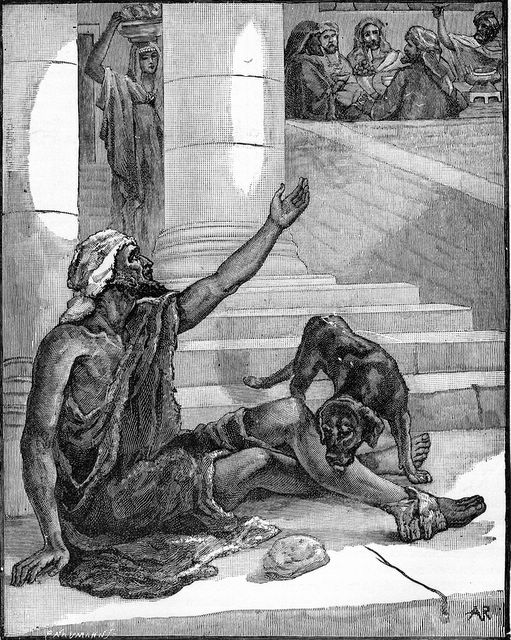
We often forget the poor. In today’s Gospel, Jesus tells us about the rich man who dressed in the finest clothes and ate the finest foods every, single day. While Lazarus, a sick, poor, starving man lays at his doorstep. When these men die, Lazarus goes to Heaven and the rich man goes to Hell.
Why did the rich man go to Hell? Was it because he was rich, or because he had the finest clothes and the finest food? No. Pope John Paul II said of this Gospel, “Nowhere does Christ condemn the mere possession of earthly goods as such. Instead he pronounces very harsh words against those who use their possessions in a selfish way, without paying attention to the needs of others.” (Homily in Yankee Stadium, 2 October 1979.) The rich man went to Hell, not because of his riches, but because he ignored the poor man, Lazarus.
Jesus tells us that Lazarus would gladly have eaten of the scraps that fell from the rich man’s table. In those days, there were no such things as napkins. So the very wealthy would wipe their hands clean with pieces of bread and throw them onto the ground. These are the scraps Lazarus would have gladly eaten. But Lazarus does not get so much as a scrap because the rich man ignores him.
We must not forget our brothers and sisters who have no bed, no hot water, no food, no job, no clothing, no home, no one to love them or pray for them. We who have so much, must be ever mindful and ready to help those who have so little. The Second Vatican Council reminds us of this obligation in its document, Gaudium et Spes which states, “Everyone must consider his every neighbor without exception as another self, taking into account first of all his life and the means necessary to living it with dignity so as not to imitate the rich man who had no concern for the poor man Lazarus.” (G&S 27).
And we, above all people; and at this time, above all other times, should be mindful of the poor. For this weekend, we celebrate the feast of our patron Saint: Saint Vincent de Paul who dedicated his entire life to imploring the wealthy to give generously of their resources for the sake of the poor. We’re familiar with this work of St. Vincent de Paul for the poor; he also ministered to condemned prisoners who would lay on damp dungeon floors, while they were covered with vermin and sores, whose only food was black bread and water. Sounds like Lazarus doesn’t it?
St. Vincent de Paul the man did not forget the poor. And St. Vincent de Paul the parish will not forget the poor.
We will be mindful of the poor through the three acts of penance: prayer, almsgiving and fasting. We will be mindful of the poor in our prayer at this Mass. We will be mindful of the poor in our second collection today which is for the St. Vincent de Paul Society. And we must be mindful of the poor through fasting.
Fasting is not just something we do during Fridays in Lent. As Catholics we are to offer some form of penance every Friday of the year: be it abstaining from meat, or fasting from a meal, or walking the stations of the cross, or praying a rosary. (Code of Canon Law: #1249-1253). We do this every Friday because we offer it as a penance for our sins to Jesus who gave his life for us on Good Friday.
And we offer it, not just to deny ourselves of too much food, or drink, or pleasure; but also so that we may be in communion with our brothers and sisters who do not have what we have.
This doesn’t mean, we cannot enjoy the good things we have. Jesus wants us to relish his gifts which we have received from his bounty. Jesus wants us to have feasts. That’s why days that honor Jesus, Mary and the Saints such as today are called feasts; because Christians would celebrate these days with feasts. And that’s what we're doing this weekend at our VincentFest (Fest by the way, means feast). We will enjoy good food and good company.
We Catholics are feasting people. We’re also fasting people. So this weekend, let us observe VincentFest. And this Friday, let each of us observe a VincentFast.
At this Mass, pray about how you want to fast this Friday as a way to be in communion with our poor brothers and sisters around the world; then when you go home, write it down on your calendar so you won’t forget. Maybe you’ll abstain from meat. Maybe you’ll skip a meal. Maybe you’ll fast from your bed and sleep on the floor Friday night. Maybe you’ll fast from hot water and take a cold shower Friday morning.
We will not ignore our poor brothers and sisters lying at our doorstep. May this Eucharist inspire us to spend a moment this Friday to live in communion with them.